Proving God’s Existence?

Christendom College offers a in-depth and insightful course called “Proving God Existence. Here is a review of the course through the perspective of Exploring the Gap Series.

Click here: Proving God’s Existence by Christendom College, Dr. Wunsch


This course was excellent!  I especially appreciated the depth into Aquinas’ arguments. So a special thanks goes to Dr. Wunsch for such an insightful presentation.

Now, in the tradition of Philosophical dialog, I respectfully share the following comments.

Point 1: Aristotle’s  and Aquinas’ Emphasis on the Observable.

It is important to emphasize the central role of observation of the universe in which we find ourselves, the Universe of the Observable. This was highlighted, particularly in the first two lectures. 

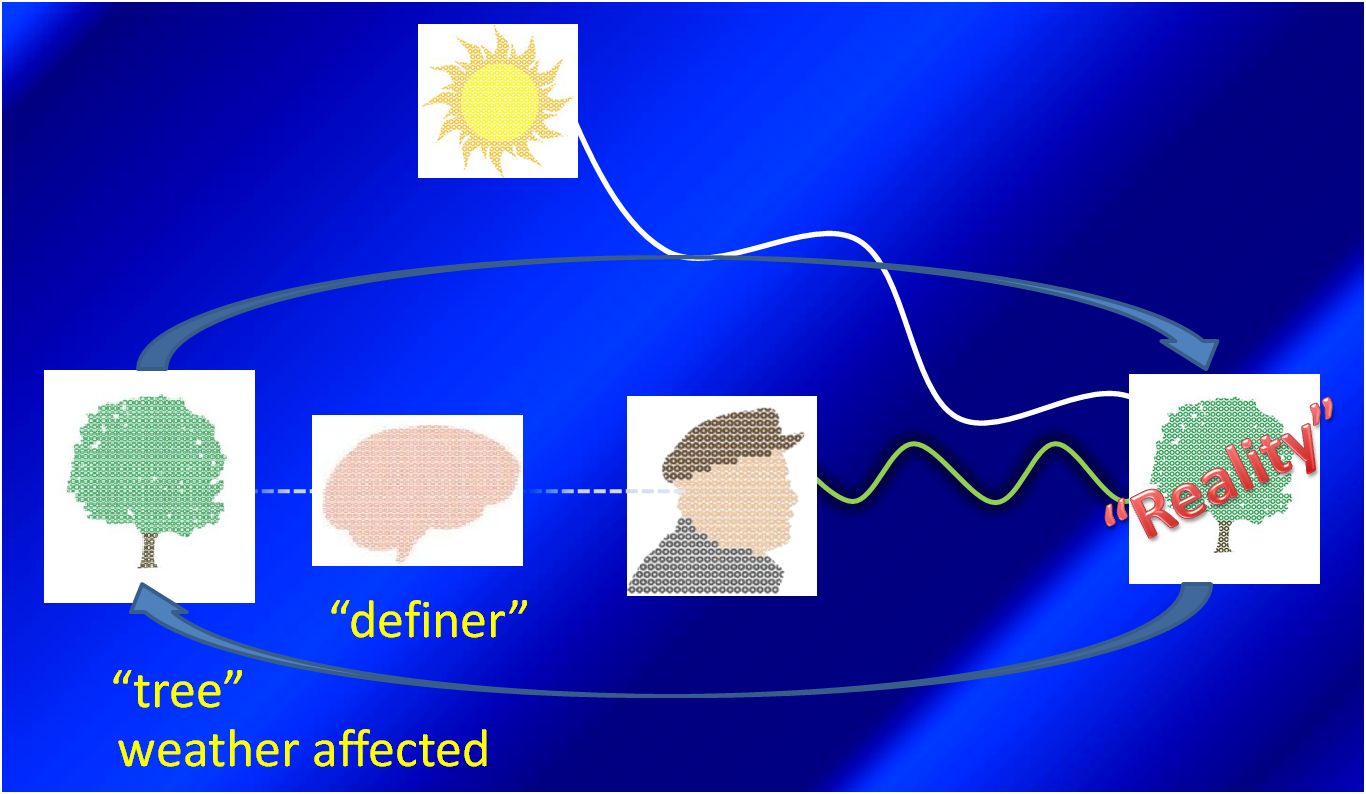
In the years since Thomas Aquinas incorporated Aristotle’s Metaphysics into Christian Theology and Philosophy, humans have made dramatic advances in the process, understanding, and conceptualization of human observation.  (See the attached graphic below)

Point 2: Conceptualizing Cause-and-Effect

Drawing from the Universe of the Observable (Point 1), humans have incorporated the concept of cause-and-affect, into most fields of contemporary science, it is undoubtedly foundational to science.
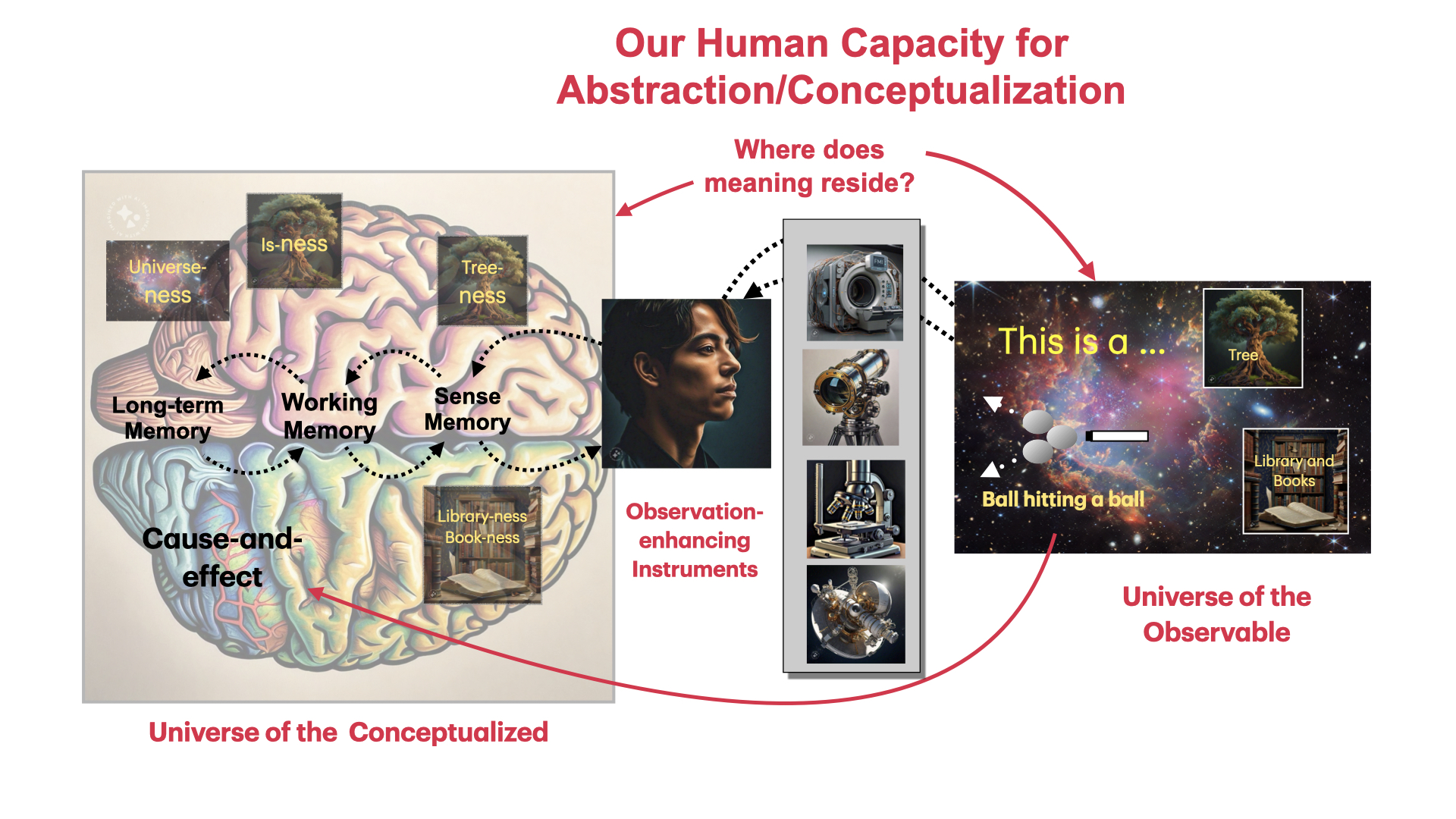
Note this relationship reflected in the figure between the Universe of the Observable and the Universe of the Conceptualized.

Of particular importance to the topic at hand is the application of cause-and-effect within biological sciences of genetics, biology, and ecology.   

Now consider this quote from Wunsch’s lecture, updated to address content in the figure.

But this [cause and effect] cannot go on to infinity, because then there would be no first mover, and consequently, no other mover; seeing that subsequent movers move only inasmuch as they are put in motion by a [previous] mover; as the [pool stick] moves only because it is put in motion by the [pool player’s] hand.  Therefore it is necessary to arrive at a first mover, put in motion by no other, and this everyone understands to be God.”

Focus on the use to the term “mover” as a cause; the meaning includes the concept of personhood (whose meaning is not found in the Universe of the Observed).  It is this limited scope representation that Dr. Wunsch’s is scaling up to include God. It is questionable this increase in scope accomplishes what it intended, which is the necessity of God to explain the attribute of existence.

But when it comes to the Universe of the Observable, has cause and effect proven to be limited?  

Point 3: Is Cause-and-Effect Infinite?

Brian Thomas Swimme and Mary Evelyn Tucker trace an uninterrupted stream of cause-and-effect In their book “Journey of the Universe”. It traces backwards through complex civilizations, human life,  the origins of life, the birth of solar systems, the formation of galaxies, to the beginning of our universe.  

While the Big Bang tends to indicate a First Cause, there are four models providing cause-and-effect based explanations of what caused the Big Bang.

Point 4: Non-personhood Transition 

Now consider this second quote.  It is from Lesson 5, 2:07-2:34

They begin with an idea and try to argue out to reality.  Instead, a beginning with an existential judgement about sensible things and arguing ultimately that certain changes in them can only be explained if a being exists by itself that is able to account for that change.  And what is that change in the first place?  It’s the movement from the potency to exist to actually existing.

In this quote, the “change” that “can only be explained if a being exists” is a “movement from [potentiality] to exist to the actually existing”. (I submit that potentiality or potential is closer to Aristotle’s philosophy)

Here is where 804 years of advancement in human knowledge offers a dramatically different perspective.  Each human gains the attribute of existence following a long line of cause-and-effects. 

Beginning with conception, we find a potential of either a male or female.  Cause-and-effect explains the swimming sperm ending in a change for a potential human to an actual person.

Nowhere in this sequence is ether evidence of ,or the necessity for “that certain changes in them can only be explained if a being exists by itself that is able to account for that change.”

Point 5: The Cause-and-Effect of Non-equilibrium Thermodynamics  

A very significant, even concept-shattering field is the field of on-equilibrium hermodynamics. Consider this quote from by Jeremy England.

The key point will be to realize that, just as living things have specialized properties determined by their genes that they have inherited from their ancestors, so, too, do collections of physically interacting particles have specialized properties that come from the past shapes into which they’ve been assembled. By continually getting pushed and knocked around by patterns presented in the environment, matter can undergo a continual exploration of the space of possible shapes whose rhythm and form become matched to those patterns in ways that look an awful lot like living. (p. 4). 

Basically, Non-equilibrium thermodynamics constitutes a cause-and-effect description of how objects within the Universe of the Observed gain the attribute of existence because their form is assembled “by continually getting pushed and knocked around by patters presented in the environment”.

Note the use of the term “form”.

Conclusion

Ultimately, the central philosophical issue is our nature as humans. 

While Aristotle declared us to be “Rational Animals”, our human progress perhaps calls for an update. 

This writer proposes this update include an Observer Observing combined with Bearer of Meaning. 

Contained within our nature as Bearer of Meaning is our Capacity for Abstraction/Conceptualization. Events observed become conceptualized, thus their meaning ultimately reside within each individuals complex neural network.

Aristotle and Aquinas shares this nature with the rest of us. So when they propose the movement from potentiality to actual, they reflect a high level of abstraction. We now have much more complex conceptualization of potential and actual with a wide range of cause-and-affect based models.
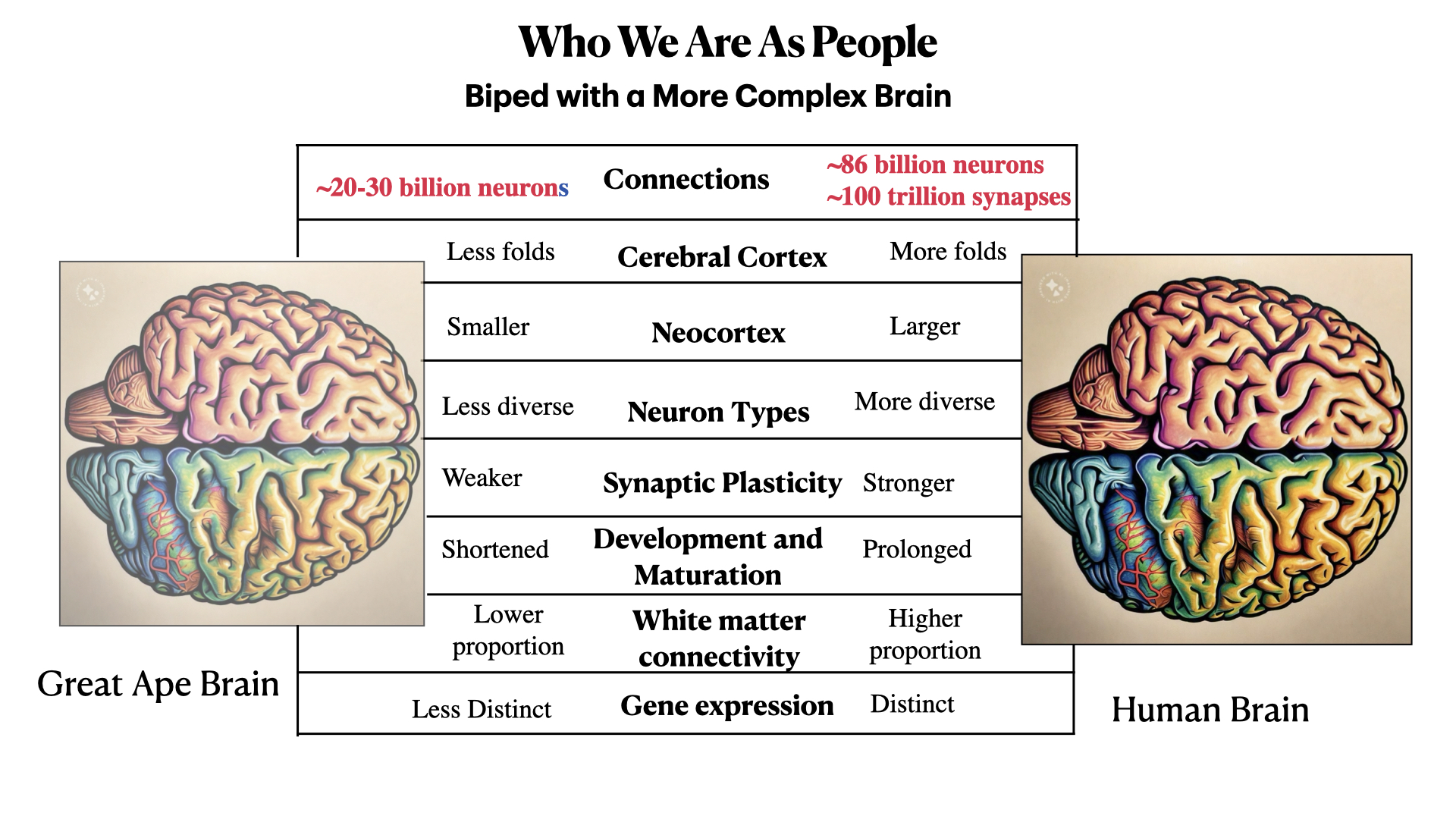
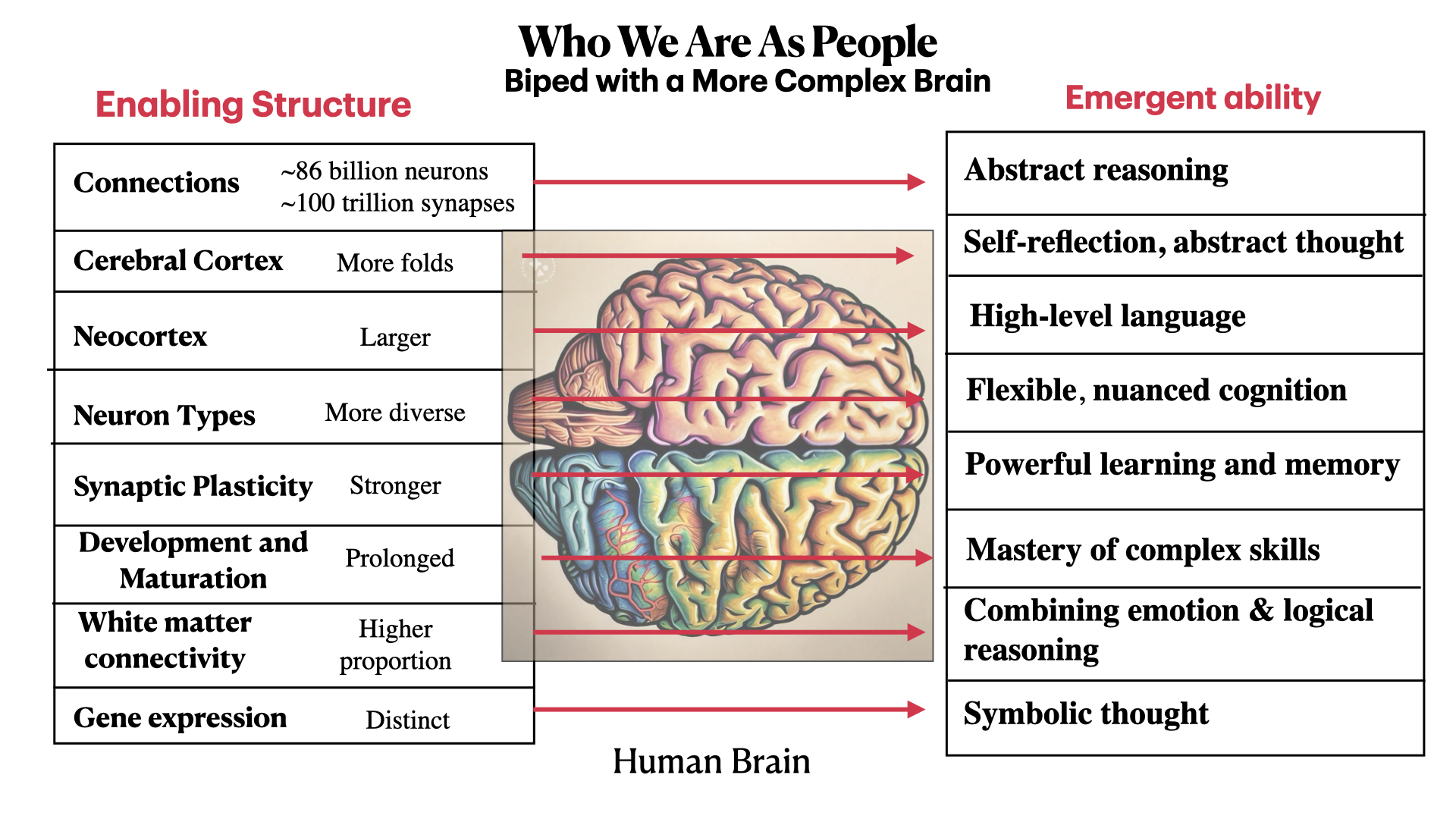
Our Complex Brains Our Essence!?

Essence is the descriptive word for what makes something what it is.

It is a largely philosophical term, not often discussed in polite conversations. Students in an Introduction to Philosophy class is where most people first encounter the term(?).

In Exploring the Gap between Science and Religion I proposed our nature (essence) is that of definer.

I wrote an updated proposal that people are bearers of meaning in Volume 7: An Observer Centric Philosophy of Science, then renamed the volume to Who We are as People.

The Exploring the Gap Series now documents how our complex brains enables our complex language and culture, which combined makes up our complex essence. This essence applies to all the philosophical topics/books in the series.

Our brains compared to that of Great Ape Brains shows our essence based on increased capacity/

Emergence = The whole is more than the sum of the parts. Therefore, the highly complex brains of people is the enables complex language-related capacities of people.

A Change in Perspective

Renamed Volume 7

Originally, Volume 7 was titled “An Observer-centric Philosophy of Science”. The idea for this content arose when I noticed that the current the field of Philosophy of Science seemed to ignore our role as observers.

As I neared completion of the first draft for sections 1 and 2, it became clear that what I was really writing was an expanded thesis on humans as definers. After several weeks of contemplating a renaming, I decided on What We are as People.

Why this title? I wanted it to be a universal statement about our nature, without any unintended narrowing the essential attributes which would excludd gender, skin color, age, cultural heritage, religious beliefs, or the era in which people lived.

What We are As People will now have four sections (if, of course I ever finish it — snicker–):

  1. The Observer Observing
  2. People as Bears of Meaning
  3. Perhaps the Hard Problem of Consciousness is not so Hard After All
  4. The Complexity of Our Nature

This change in perspective required an update to the conceptual content map of the Exploring the Gap Series.

Software Updates as Metaphor for the Evolution of Human Conceptualization

Update versions for Human Conceptualization Worldview

Here is a timeline showing the upgrading dates of the Human Conceptualization Worldview (HCW).

HCW depicts our human use of bearers of meaning since early humanity. 

Software undergoing upgrades provides an ideal metaphor, explaining our changing human conceptualization. (HCW)

Version 1.0, Symbolic and Proto-Religious is humanity’s initial expression of our human nature as bearers of meaning. It occurred before humans formed religion and fabricated gods.

Our HCW upgrades, as the chart shows, have gone from cave art to Polytheism to Human Conceptualism. 

Yes. 

Human Conceptualism is a newly coined phrase to depict the beta test HCW Version 6.0.

Dashed lines represent humans who have not upgraded to the new version of HCW.

The dotted line reaching back into history represents the fact that HCW 6.0 is an explanation of the explanations. As such, it provides a philosophical framework that invites us to see each in the ways that we are alike, not in what that we differ.

This nature applies regardless of gender, skin color, bald or harry-headed, tall or short, religious or atheist, the culture in which we live, or even the era in which we lived. 

Thus the backward pointing arrow.

Paradox: An Insight into the Nature of Truth

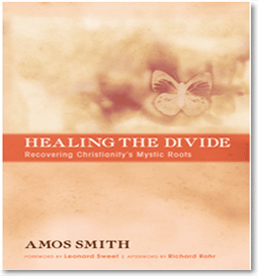
I recently finished reading Healing the Divide by Amos Smith.  See http://amossmith.org.

Since we have a shared interest, we exchanged books last fall, and I finally got around to reading it. Am I glad I did!

We have scheduled a discussion at his church, Church of the Painted Hills, UCC, in Tucson Arizona to share our perspective insights. The date will be May 4th, 2014.

HealingDivide

What resonated for me about Healing the Divide was his extensive discussion of the role of paradox in understanding  the nature of the Divine. (I was 2/3 of the way through the book thinking the title was “Healing the Divine.”)

Amos specifically focusses on the paradox within Christian theology of Jesus being both human and divine, labeling it “The Jesus Paradox.”

Amos Smith provided a much-appreciated context of this paradox by describing the linguistic roots of early Christian thought found in the Greek concept of  Miaphysite: “one dynamic united nature.”

Amos’ use of paradox connects with me because when writing “Exploring the Gap between Science and Religion” I found myself exploring paradox to be a useful in understanding the universe around us.

I define the Paradox Principle on page 136 as follows:

Things are both what the are defined to be and their exact opposite.

I go on to say: “The paradox principle is the vortex where definition meets the indivisible universe.”

On page 17 of Healing the Divide, Amos provides a quote from author Thomas Keating that reflects this same insight regarding paradox:

 The great truths can only be expressed in paradox.
— Thomas Keating.

Listening to the Still Small Voice of Jesus

In our human efforts to understand the universe around us, we develop models to explain the observations we make. These models constitute representations of what we often label the “real thing.”

Models include people, both current and historic, like for example, Jesus. A key element in this human model-making process is an inconsistency between what we observe and the model we currently hold.

These inconsistencies-which I label as anomalies–are common when it comes to the religion. The following poem highlights anomalies between the way a Christian society conducts itself, and the teachings of the person of Jesus.

DSCN0577

Nature’s silent beauty, a megaphone for the Still Small Voice

Listening to the Still Small Voice of Jesus

Deep in the depths of prayer, in a meditative state
between awake and Enlightenment,
The Still Small Voice of Jesus whispers:

Whoever wants to be my disciple must deny themselves 
and take up their cross and follow me. (1)
 
But I could not quite hear over the clatter of my self-centered Ego.
So I asked Me to step aside…
…. Maybe then I could hear the Still Small Voice of Jesus.
                                  * * *
I listened for the still small voice of Jesus,
And he advised me to be clean, both inside and outwardly:

But now as for what is inside you—be generous to the poor,
and everything will be clean for you. (2)

But I did could not hear over the clamor for tax cuts for the wealthy,
and the screams to balance budget by cutting food stamps…
So I asked Religious Right to step aside…
…Maybe then I could hear the Still Small Voice of Jesus.
                                  * * *
I listened once again for the still small voice of Jesus.
He replied with a roadmap for a place beyond these earlthy riches:
Go, sell everything you have and give it to the poor,
and you will have treasure in heaven.
Then come, follow me.  (3)
But the message was garbled by my Christian education.
So I asked John Calvin to step aside…
… Maybe then I could hear the Still Small Voice of Jesus.
                                  * * *
I continued listening, now with anxious anticipation.
Maybe this time I would hear the Still Small Voice of Jesus.
In response, Jesus spoke these words:
Blessed are the peacemakers,    
for they will be called children of God.  (4)
But I did could not hear over the ear-splitting thunderclap
of Christian-funded bombs raining death down on innocents,
American-built ordnance slaughtering a nation for weapons it did not possess.
Nor could I hear over the wailing of weeping widows, morning the untimely deaths
of husbands and children.
                                  * * *
Upset about the blood flowing in Afghan and Iraq streets,
I asked my church if it had heard Jesus’ voice over the

Splatter of bloody body parts against pock-marked walls
of children blown apart by drone-dropped ordinance,
then over the justifying shouts of “collateral damage.”

…Maybe with church’s amplfied voice I could hear the Still Small Voice of Jesus.
                                  * * *
Now with growing apprehension,I listened to hear for the Still Small Voice of Jesus
over the years in the Sunday morning Sermon…
But there was only silence from the pulpit. (5)

So I asked Martin Luther and Emperor Constantine (6)
 to step aside…
…. Maybe then I could hear the Still Small Voice of Jesus.
                                  * * *
Wondering whether I would ever hear Jesus, I made one last effort
to hear the Still Small Voice of Jesus.
And Jesus responded to my quest by saying:
Put your gun back in its place, 
for those who draw the gun will die by the gun. (7)
But I could hear nothing over the crack of automatic gunfire echoing in schools and movie theaters, and over the screams of terrified children —and the squawking about Second Amendment Rights, with pseudo-moral claims of:

Kill the bad guy before the bad guy kills you.  (8)

 
So I asked James Madison (9), and Alan Gottlieb, (10) to step aside…
…. Maybe finally I will hear the Still Small Voice of Jesus.
                                  * * *

In a flash of light-filled clarity, Jesus’ Still Small Voice became a glorious chorus of spirit-filled souls, now unfilteredby the dual millennia of human distortion.

And standing before me stood a Divine chorus
of God’s spokespersons, basking in the profound
moral insights of God’s Wisdom.
Standing next to Jesus, Sophia’s sweet soprano voice
added a blended balance (11) to the
radical Truths carried by the choir’s song.
My Wholly-healed ears cringed at the challenging voice
of Isaiah, sung out a drum-beat melody:
    Woe to those who make unjust laws,
    to those who issue oppressive decrees,
    to deprive the poor of their rights and withhold 
    justice from the oppressed of my people (12).
My heart pounded with the rapid rhythm
of Solomon-penned record of Sophia’s Wisdom (13):

Whoever oppresses the poor shows contempt for their Maker, but whoever is kind to the needy honors God. (14)

The Divinely-inspired once more struck up melody to Isaiah’s lyrics,
and from the clarion voice of Mohammed I heard: (15)

Scoundrels use wicked methods,
they make up evil schemes to destroy the poor with lies,
even when the plea of the needy is just.
 (16)

My heart contined to beat to the pounding rhythm
as the choir’s angelic voices rang out the invitation-filled finale:

    
Get wisdom, get understanding; do not forget my words or turn away from them.
Do not forsake wisdom, and she will protect you;
love her, and she will watch over you.
The beginning of wisdom is this: Get wisdom. 
(17)

Then Sophia solo concluded the verse:

But when you give a banquet, invite the poor, the crippled, the lame, the blind, and you will be blessed. (18)

And Jesus’ voice became not-so-still and not-so-silent.
                                  * * *
Footnotes: 
(5) In interest of full disclosure, many denominations at the church-wide level look a position against the war in Iraq.
(6) Justification for war in Christianity is based on the “Just War.” This theory was the ethics of the Roman
     Empire and Emperor Constantine, not Jesus. So when a Christian denomination looks to the Just
     War Theory, they are not listening Jesus’ teaching of “Blessed are the Peacemakers…”  See
(7) Okay. Okay, I substituted “gun” for “sword” in this Matthew 26:51-52 text. See
     My rationale is that the sword is the current gun’s great grandfather. The evil embodied in the sword has been passed
     down to it’s anscestors. Our current generation, as did those in Jesus’ time, look the The Almighty Sword as
     their Lord and Savior.
(8) National Rifle Association Executive Vice President Wayne LaPierre actually said, “The only thing that stops a bad
     guy with a gun is a good guy with a gun.” Translated, this means, “Kill before being killed.”  Not exactly
     what Jesus meant when he said “those that take up the gun.” See
(9) James Madison is acknowledged to be the “author” of the first 10 amendments, but no one single
(10) Alan Gottlieb is founder of the Second Amendment Foundation. See /http://www.saf.org
(11) Sophia is name given to God’s Wisdom. See Proverbs  1: 20-33 “Wisdom’s Rebuke” identifies God’s wisdom as female.
(11) As opposed to Occum’s razor. See http://en.wikipedia.org/wiki/Philosophic_burden_of_proof
(12) Sophia is the femine name of God’s wisdom. Her voice is found in Solomon’s Proverbs and in Apocrapha book “The Wisdom of Solomon.”
(13) See Isaiah 10:1-2.
(14) See Proverbs 14: 31.
(15) Mohammed and Jesus both share the heritage of the Hebrew prophets.
(16) See Isaiah 32:7.
(17) Proverbs 4:5-7 See
(17) Luke 14:13-14 See

http://www.biblegateway.com/passage/?search=Luke%2014:13-14&version=NIV

Taking The Quantum Leap into A History of God

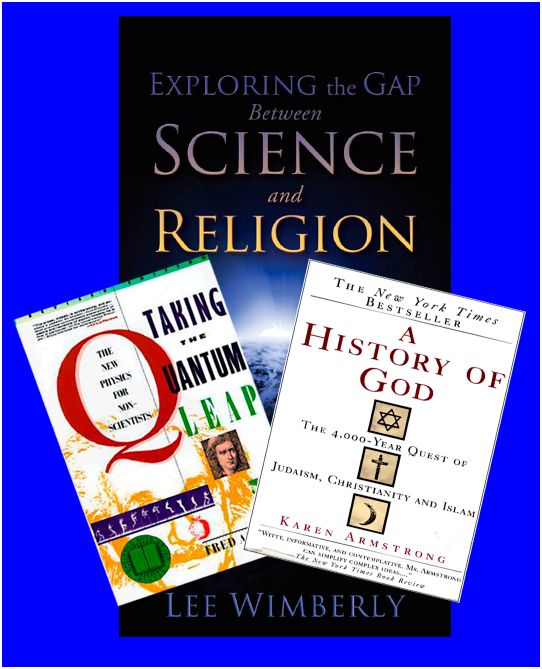
I recently read two books in parallel:  Taking the Quantum Leap by Fred Alan Wolf and A History of God by Karen Armstrong.

Three book covers

Taking the Quantum Leap and A History of God viewed through the perspective of Exploring the Gap between Science and Religion.

My goal in reading them in parallel was to find common threads between these books and the concepts presented in Exploring the Gap between Science and Religion.   

The most intriguing insight was a single Biblical reference found in all three book. It is the story of Moses and the burning bush found in Exodus, Chapter 3, verses 13 and 14:

Moses said to God, “Suppose I go to the Israelites and say to them, ‘The God of your fathers has sent me to you,’ and they ask me, ‘What is his name?’ Then what shall I tell them?”

God said to Moses, “I am who I am. This is what you are to say to the Israelites: ‘I am has sent me to you.’” (a)

In Exploring the Gap I refer God’s “I am” statement as one of  six Biblical stories that are “Themes of Unity in the Christian Bible.” (b)  Regretfully, I did not expand on that topic as much as I would have liked.

In A History of God Karen Armstrong states the following:

Instead of revealing his name directly, he answers “I am Who I Am (Ebyeh asber ebyeh) …(c)

There was to be no discussion of God’s nature and certainly no attempt to manipulate him as pagans sometimes did when they recited the name s of their gods. Yahweh is the Unconditional One: I shall be that which I shall be. (d)

In Taking the Quantum Leap, Wolf states the following regarding Moses’ experience with the burning bush:

The first documented case of quantum consciousness may have been Moses. When he asked “Who are you?” of the Presence felt at the burning bush, the answer came “I AM THAT I AM.” Moses then recognized that, within him, the God Voice now spoke as Moses.

(a) BibleGateway.com, http://www.biblegateway.com/passage/?search=Exodus%203:13-14&version=NIV

(b) Exploring the Gap between Science and Religion, Book Publishers Network, 2011, p. 66. Note: the underline added by me.

(c) A History of God, Ballentine Books, New York, 1993, p. 21

(d) A History of God, Ballentine Books, New York, 1993, p. 22

(e) Taking the Quantum Leap, Harper & Row, New York, 1989

The question: “DO YOU BELIEVE IN Apes MAN – Man was a Monkey?

The question “DO YOU BELIEVE IN Apes MAN – Man was a Monkey?” caught my attention. It was obviously asking about the reader’s position regarding biological Evolution, and most likely as it related to Creationism.

I found this question posed on a LinkedIn group called “New Philosophy Network.” It was submitted by a a teacher at King Saud University in Saudi Arabia. In his opening argument he states “I reject this fallacy that We develop From the Animal Kingdom, monkey to human?”

I found the question and subsequent dialog intriguing because the whole “creation versus evolution” has been the hottest topics related to the relationship between science and religion.

AN EVOLUTIONIST WOULD AGREE

I submit that an evolutionist fully would agree that he or she also does not believe that people evolved from monkeys!

I state this for two reasons.

First, the model that we know as evolution is not based on belief. It is based instead on observations made by biologists and geneticists. This body of detailed recorded observation spans several hundred—no several thousand—years. The resulting biological model has evolved, ever changing as new observations make previous models obsolete.

This process is illustrated in this simple model of someone observing a tree.

The model is based on observation.

From these observations, the discipline known as evolutionary biologists has built a detailed set of interlocking models that represents the content of their body of observations. These models include genetics, physical characteristics, and the environment to name a few.

Not being a trained biologist, I must admit that I am not qualified to critique the details of their various models.  What I do know is that the cornerstone of science is verification, a process that works to ensure that the observations and as much as possible are objective.

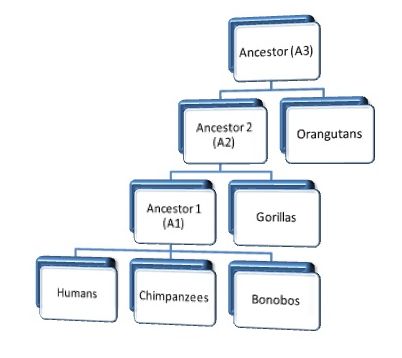
Second, as the evolutionary model currently stands, humans, apes, and monkeys share a common ancestor. Here is a representation of the common ancestor to apes, monkeys, and people. So no. Humans have not evolved from monkeys, at least as the evolutionary model stands today. Here is a graph showing how we share a common ancestor.

Graph depicting common ancestor

Graph of common ancestors (1)

Let me submit that the author is posing the wrong—and irrelevant—question.

A person of faith should be asking, “Is my relationship with Divine is so tenuous that a human model of the universe, such as the earth rotating around the sun or a biologist’s representation of animal genealogy, challenges that relationship?”

(1) “Why We Did Not Evolve from Monkeys: Human Common Ancestry Explained,”  by ConnorDavidson http://searchwarp.com/swa840509-Why-We-Didnt-Evolve-From-Monkeys-Human-Common-Ancestry-Explained.htm

Galileo’s Hammer: The Telescope

When Galileo put a telescope between himself and universe, he changed everything!

Well. Not really everything!

What he did was knock a crack in a long-held conceptual wall. It was a wall designed by philosophers Plato and Aristotle, and constructed  by the Western branch of the Christian church. (1)

His simple telescope (which had the magnification of a normal pair of binoculars) gave him more detailed observations than he could get from the naked eye.

His telescope revealed the Milky Way, which appears wonderful fuzzy blur of light when looking with the naked eye on a  clear night, was actually composed of thousands and thousands of individual stars, very far away from earth.” (2)

EarthsLocationInTheMilkyWay

Our Place in the Milky Way

Skeptics didn’t trust either the instrument  nor the models he built based his observations.

Each revelation called into question what people thought about the heavens. Some thought Galileo’s ideas were based on tricks played by his new ‘tube’, as the telescope was often called, because what could not be seen by the naked eye might not be there. Galileo had to try to convince people that what his telescope showed was real.” (3)

Galileo’s story is the classic example of the competition between science and religion. A competition for the dominance in worldviews.

Ultimately this simple telescope of his became the hammer that cracked the rigid wall of religion. The crack initially created by Galileo has become a continuous and growing breech. With each new cycle of observation, improved measuring instruments, and updated models, new anomalies arise between science’s insights and the remnants of  religion’s crumbling wall.

Religions either address these anomalies, or fade into irrelevancy.

The Hubble Telescope Blasts Away at the Wall?

In the tradition the telescope, The Hubble Telescope continues to reveal challenging  information. This challenge is for both science and religion, but the very structure of science makes it more flexible when encountering this new information.

“Since the earliest days of astronomy, since the time of Galileo, astronomers have shared a single goal — to see more, see farther, see deeper.

The Hubble Space Telescope’s launch in 1990 sped humanity to one of its greatest advances in that journey.”(4)

3DMapofUniverse

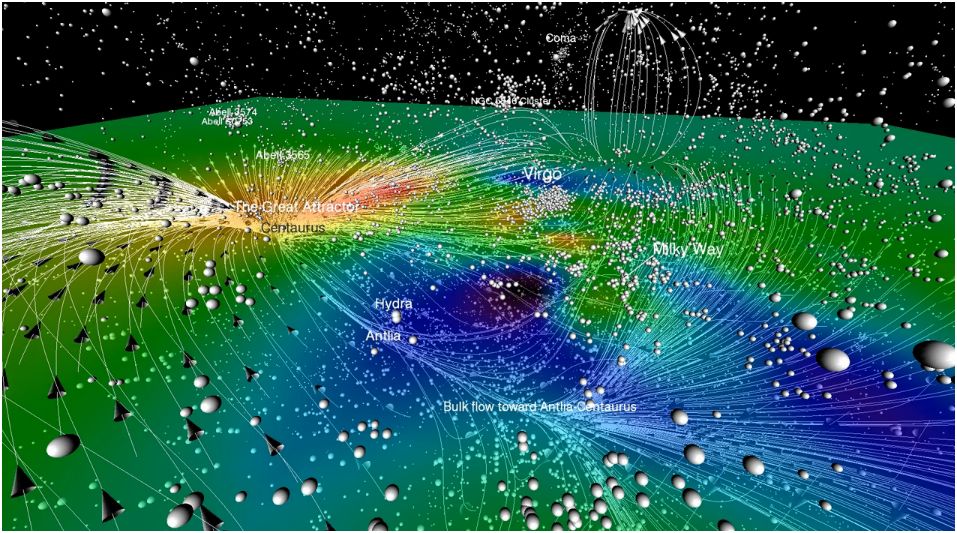
A Snapshot of the 3D Model of the Universe (5)

With it’s less obstructed view of the universe, today’s astronomer’s have been able to construct an amazing  3D map of universe. (6)

The creator of the 3D map of the universe–Brent Tully–followed in Galileo’s footsteps when he created this detailed model of the universe. One feels a sense of awe and wonderment at the vastness shown by the map.

And frankly, it blasts away at what remains of religion’s conceptual wall. To take the challenge, watch the video: http://irfu.cea.fr/cosmography

(1) Exploring the Gap between Science and Religion, Chapter Six: “Shall I Worship the God I Create or the God that Created Me”, p. 42, Figure 12 — Contributors to the Western God Model.

(2) “A Little History of Science, p 65.

(3) Ibid, p 65.

(4) “Hubble Site,” “Hubble Essentials.” http://hubblesite.org/the_telescope/hubble_essentials/

(5) Picture taken from the video walk-through of the 3D Model, http://irfu.cea.fr/cosmography

(6) Discover Magazine “The Most Map You’ll See Today,” http://blogs.discovermagazine.com/outthere/2013/06/16/the-most-amazing-map-youll-see-today-no-matter-what-day-it-is/#.UcoTLTuThyL

There are Always Two trees…and Two Gods

An insight one discovers when exploring the gap between science and religion is that there are always two “somethings!”

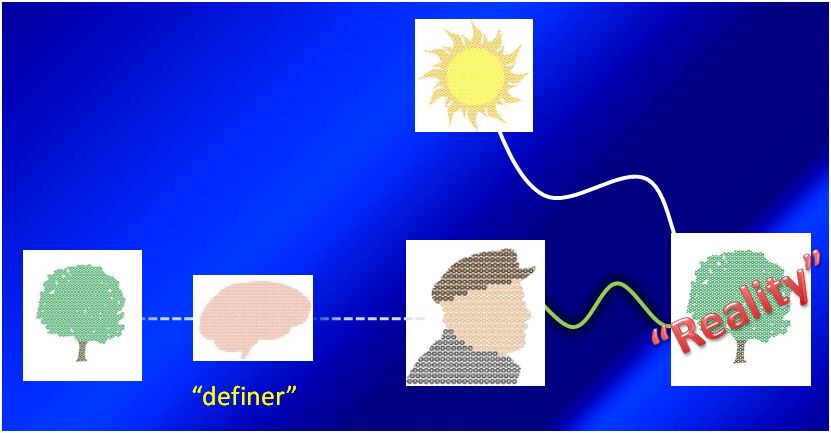
There is the object “out there” which is the subject of an individual’s observation, and there is the representation of that object in that humans as “definers” create.

There is a bark-encased, branch-spreading, leaf-bearing (or needle bearing) object, and then there is the representation of that something that we have in our minds. It is of course, the tree. This representation is so pervasive, we almost never attend to it.

Trees. Two of them. The one on the right the one outside of us. The one on the left, our model.

Note the philosophical insight: there are two trees.

This “twoness” is not so clear when it comes to intangible “things,” such as love, smell, and transcendental object humans label as “God.”

The labeling of something as “god” or “God” is not limited to those who believe in God. Atheists have a model of god, to which they attribute the characteristic of “non-existent.”

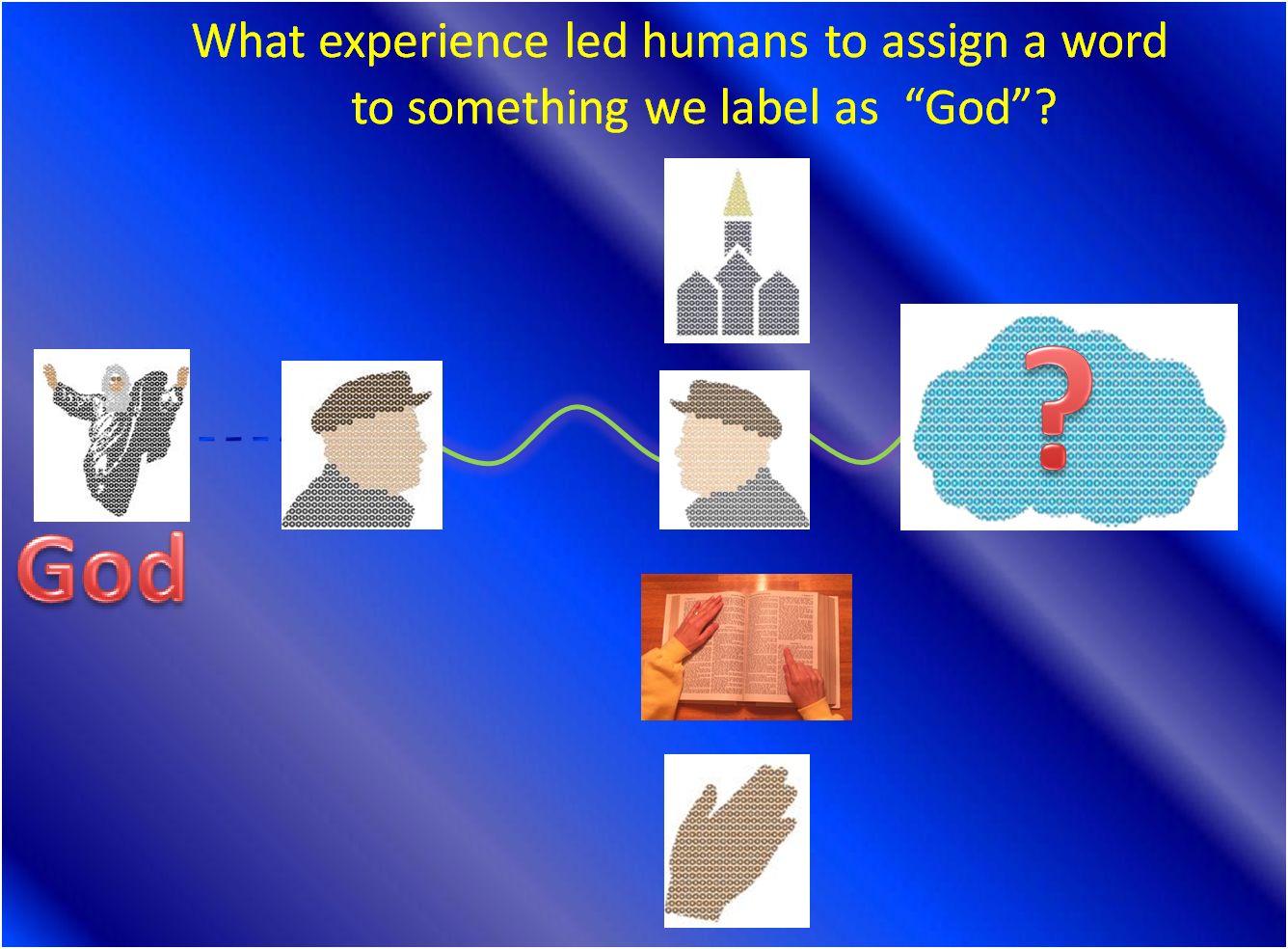
Whether one is an atheist or a theist, the fact that humans created of the term and concept that deals with the transcendental raises the question, “What experience has led humans to label something as “God.”

UniversalSenseOfTheBehond

An experience of something bigger than oneself…

Perhaps it is what Sociologists report as a universal experience of something bigger than ourselves–aka transcendental. “Universal” in this case refers to a global phenomena where every culture has those in their society who testify to this experience.

From this experience of the transcendental–that which transcends the individual (aka ego)–we humans have modeled this experience is different ways. For example, eastern philosophy’s representation as Nirvana and/or the opening lotus blossom.

Notice that in next graphic, the Abrahamic religion’s representation of God as a old male with a long beard and flowing robes. That representation is shaped by other people, the prevailing culture, scripture & other written works, and prayer & meditation.

TheGodHumansCreated

A god created by humans, is a representation of “something?”

For people who have a strong religious sense then, the challenging question becomes:

Whom shall I worship? The god I created, or the God that created me?

The next logical question is:

How do I know which one?