Christendom College offers a in-depth and insightful course called “Proving God Existence. Here is a review of the course through the perspective of Exploring the Gap Series.
Click here: Proving God’s Existence by Christendom College, Dr. Wunsch
This course was excellent! I especially appreciated the depth into Aquinas’ arguments. So a special thanks goes to Dr. Wunsch for such an insightful presentation.
Now, in the tradition of Philosophical dialog, I respectfully share the following comments.
Point 1: Aristotle’s and Aquinas’ Emphasis on the Observable.
It is important to emphasize the central role of observation of the universe in which we find ourselves, the Universe of the Observable. This was highlighted, particularly in the first two lectures.
In the years since Thomas Aquinas incorporated Aristotle’s Metaphysics into Christian Theology and Philosophy, humans have made dramatic advances in the process, understanding, and conceptualization of human observation. (See the attached graphic below)
Point 2: Conceptualizing Cause-and-Effect
Drawing from the Universe of the Observable (Point 1), humans have incorporated the concept of cause-and-affect, into most fields of contemporary science, it is undoubtedly foundational to science.
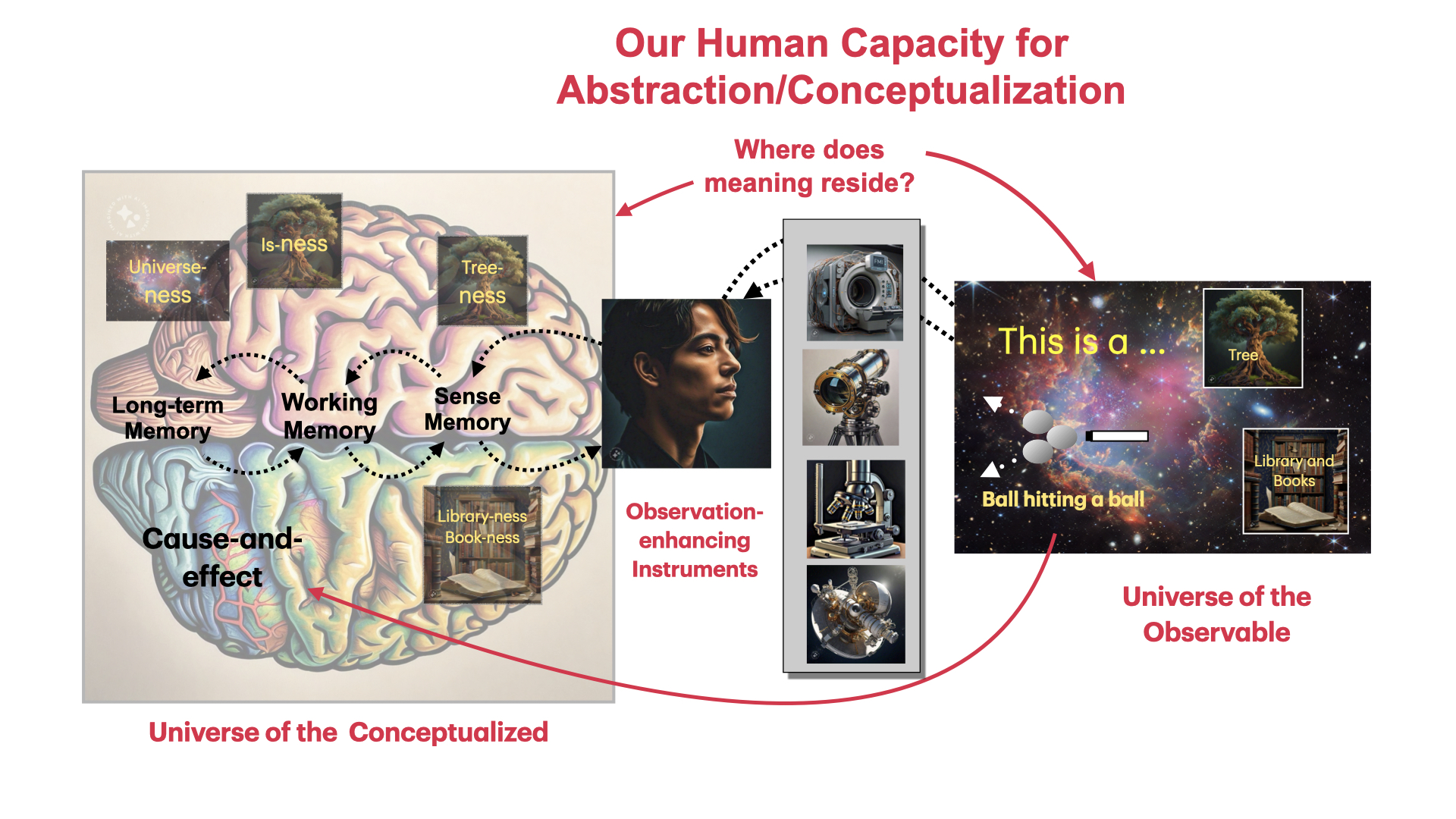
Note this relationship reflected in the figure between the Universe of the Observable and the Universe of the Conceptualized.
Of particular importance to the topic at hand is the application of cause-and-effect within biological sciences of genetics, biology, and ecology.
Now consider this quote from Wunsch’s lecture, updated to address content in the figure.
“But this [cause and effect] cannot go on to infinity, because then there would be no first mover, and consequently, no other mover; seeing that subsequent movers move only inasmuch as they are put in motion by a [previous] mover; as the [pool stick] moves only because it is put in motion by the [pool player’s] hand. Therefore it is necessary to arrive at a first mover, put in motion by no other, and this everyone understands to be God.”
Focus on the use to the term “mover” as a cause; the meaning includes the concept of personhood (whose meaning is not found in the Universe of the Observed). It is this limited scope representation that Dr. Wunsch’s is scaling up to include God. It is questionable this increase in scope accomplishes what it intended, which is the necessity of God to explain the attribute of existence.
But when it comes to the Universe of the Observable, has cause and effect proven to be limited?
Point 3: Is Cause-and-Effect Infinite?
Brian Thomas Swimme and Mary Evelyn Tucker trace an uninterrupted stream of cause-and-effect In their book “Journey of the Universe”. It traces backwards through complex civilizations, human life, the origins of life, the birth of solar systems, the formation of galaxies, to the beginning of our universe.
While the Big Bang tends to indicate a First Cause, there are four models providing cause-and-effect based explanations of what caused the Big Bang.
Point 4: Non-personhood Transition
Now consider this second quote. It is from Lesson 5, 2:07-2:34
“They begin with an idea and try to argue out to reality. Instead, a beginning with an existential judgement about sensible things and arguing ultimately that certain changes in them can only be explained if a being exists by itself that is able to account for that change. And what is that change in the first place? It’s the movement from the potency to exist to actually existing.“
In this quote, the “change” that “can only be explained if a being exists” is a “movement from [potentiality] to exist to the actually existing”. (I submit that potentiality or potential is closer to Aristotle’s philosophy)
Here is where 804 years of advancement in human knowledge offers a dramatically different perspective. Each human gains the attribute of existence following a long line of cause-and-effects.
Beginning with conception, we find a potential of either a male or female. Cause-and-effect explains the swimming sperm ending in a change for a potential human to an actual person.
Nowhere in this sequence is ether evidence of ,or the necessity for “that certain changes in them can only be explained if a being exists by itself that is able to account for that change.”
Point 5: The Cause-and-Effect of Non-equilibrium Thermodynamics
A very significant, even concept-shattering field is the field of on-equilibrium hermodynamics. Consider this quote from by Jeremy England.
The key point will be to realize that, just as living things have specialized properties determined by their genes that they have inherited from their ancestors, so, too, do collections of physically interacting particles have specialized properties that come from the past shapes into which they’ve been assembled. By continually getting pushed and knocked around by patterns presented in the environment, matter can undergo a continual exploration of the space of possible shapes whose rhythm and form become matched to those patterns in ways that look an awful lot like living. (p. 4).
Basically, Non-equilibrium thermodynamics constitutes a cause-and-effect description of how objects within the Universe of the Observed gain the attribute of existence because their form is assembled “by continually getting pushed and knocked around by patters presented in the environment”.
Note the use of the term “form”.
Conclusion
Ultimately, the central philosophical issue is our nature as humans.
While Aristotle declared us to be “Rational Animals”, our human progress perhaps calls for an update.
This writer proposes this update include an Observer Observing combined with Bearer of Meaning.
Contained within our nature as Bearer of Meaning is our Capacity for Abstraction/Conceptualization. Events observed become conceptualized, thus their meaning ultimately reside within each individuals complex neural network.
Aristotle and Aquinas shares this nature with the rest of us. So when they propose the movement from potentiality to actual, they reflect a high level of abstraction. We now have much more complex conceptualization of potential and actual with a wide range of cause-and-affect based models.