Software Updates as Metaphor for the Evolution of Human Conceptualization

Update versions for Human Conceptualization Worldview

Here is a timeline showing the upgrading dates of the Human Conceptualization Worldview (HCW).

HCW depicts our human use of bearers of meaning since early humanity. 

Software undergoing upgrades provides an ideal metaphor, explaining our changing human conceptualization. (HCW)

Version 1.0, Symbolic and Proto-Religious is humanity’s initial expression of our human nature as bearers of meaning. It occurred before humans formed religion and fabricated gods.

Our HCW upgrades, as the chart shows, have gone from cave art to Polytheism to Human Conceptualism. 

Yes. 

Human Conceptualism is a newly coined phrase to depict the beta test HCW Version 6.0.

Dashed lines represent humans who have not upgraded to the new version of HCW.

The dotted line reaching back into history represents the fact that HCW 6.0 is an explanation of the explanations. As such, it provides a philosophical framework that invites us to see each in the ways that we are alike, not in what that we differ.

This nature applies regardless of gender, skin color, bald or harry-headed, tall or short, religious or atheist, the culture in which we live, or even the era in which we lived. 

Thus the backward pointing arrow.

A 2012 Look at the story of The Rich Young Ruler

A key insight one discovers when exploring the gap between science and religion is the role of “anomalies,” which are inconsistencies or contradictions between something we observe (including reading) and the model or models we develop as a result.

We encounter these anomalies in almost all human endeavor, including science, religious beliefs, and politics.

The story below from the Christian New Testament book of Matthew 19: 13-22 highlights a stark anomaly being played out on the American political stage.

This is a 2012 rendition of “The Rich Young Ruler.” The bold characters identify where the story has been updated to connect it the context in which Americans find themselves.

The Rich Young Ruler

16Just then presidential candidate Mitt Romney came up and asked Jesus,(M) “Teacher, what good must I do to have eternal life?”(N)

17 “Why do you ask Me about what is good?”[f] Jesus said to Mitt. “There is only One who is good.[g] If you want to enter into life, keep the commandments.”(O)

18 “Which ones?” Mitt asked Him. Jesus answered:

Do not murder;
do not commit adultery;
do not steal;
do not bear false witness;(P)
19 honor your father and your mother;
and love your neighbor as yourself.(Q)[h]

20 “I have kept all these,”[i] Mitt told Him. “What do I still lack?”

21 “If you want to be perfect,”[j] Jesus said to him, “go, sell your belongings and give to the poor,(R) and you will have treasure in heaven. Then come, follow Me.”

22 When Mitt heard that command, Mitt stated his political position by saying, “I’m not concerned about the very poor—we have a safety net there. If it needs repair, I’ll fix it. I’m not concerned about the very rich, they’re doing just fine. (See http://www.politico.com/news/stories/0212/72297.html and or Google “Mitt Romney “I’m not concerned”)

And he went away grieving, because he had many possessions.

By replacing the “rich young ruler” with a living a 21st century politician we can examine and compare two contexts. It is here that we find the anomalies between the two contexts. The first context is the spiritual and values context of scripture, and second is the economic / political context in which American voters find themselves.

Placing these two contexts together quickly highlights a host of contradictions related to how we define (aka model) God, Jesus, religion, and living a life according to principles and the values as taught by Jesus himself.

After this story, Jesus teaches his disciples the meaning of the conversation between himself and the rich young ruler. Here is the wisdom that Jesus shares, which is Matthew 23-26.

Possessions and the Kingdom

23 Then Jesus said to His disciples, “I assure you: It will be hard for a rich person to enter the kingdom of heaven!(S) 24 Again I tell you, it is easier for a camel to go through the eye of a needle than for a rich person to enter the kingdom of God.”(T)

25 When the disciples heard this, they were utterly astonished and asked, “Then who can be saved?”

26 But Jesus looked at them and said, “With men this is impossible, but with God all things are possible.”(U)

To read the original from the “Holman Christian Standard Bible” following this link: http://www.biblegateway.com/passage/?search=Matthew%2019:16-26&version=HCSB

It is interesting to consider Mitt Romney’s statements about his priorities related to the rich and the poor, given God’s wisdom as spoken by Jesus.

Like I stated in the opening, a key insight one discovers when exploring the gap between science and religion is the role of “anomalies.” Discussions and dialogs about those anomalies provide those seeking to discover truth opportunities to examine what anomalies that each of us carries around within us.

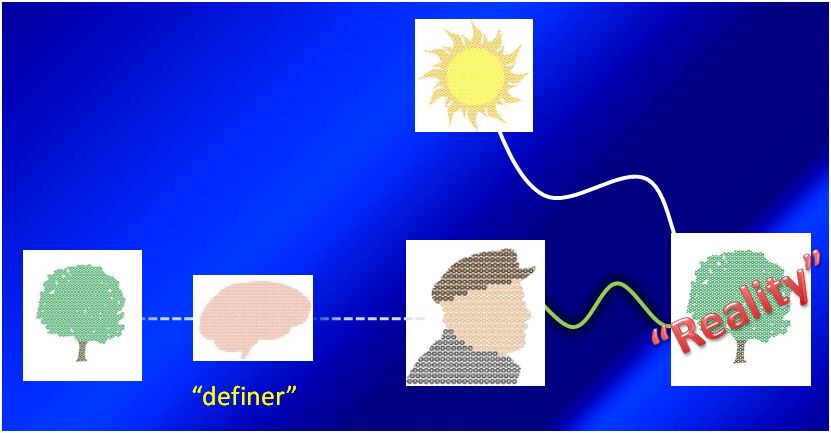
What is the nature of Truth? Is Truth self-evident?

Trees. Two of them. The one on the right the one outside of us. The one on the left, our model.

Note the philosophical insight: there are two trees.

I often start a discussion of “Exploring the Gap between Science and Religion” ( http://www.explorethegap.net) by asking the question “Is science equipped to reveal truth?” More often than not, I get the answer: “It depends on how you define truth?”

This response and other discussions have led me to explore, read, and write about “the nature of truth?”

Let me explain why the question is phrased this way. I find many instances of people either discussing truth, or claiming to hold the “absolute truth”. When I encounter such discussions, I find myself wanting to ask “what do you mean by truth?” In some settings, I have found people reluctant to tackle the question of truth, and I find many people claiming “there are many truths.”

What occurs in response, of course, isn’t truth truth? And it would appear that even though truth is illusive, and some don’t want to tackle the topic, many seem to hold firmly that there is some kind of absolute, unchangeable, immutable truth.

So here is why I ask the question “What is the nature of truth?” If we once develop detailed criteria of what truth IS, we can then apply those criteria in evaluating things which someone might claim to be true. In fact, these criteria can be—once established—used to evaluate this analysis of the nature of truth. Yes, this appears to be backwards in approach! But by doing it this way, we can have an discussion that does not start out with an unverified premise.

I found a paper posted on the web that provides a detailed analysis and discussion titled “What is the nature of truth?
Here is an outline of the areas considered by the paper. A brief definition of each follows.

  1. Truth as correspondence.
  2. Truth as a quality of independent entities.
  3. Truth as a coherence, to which I would add the term “comprehensiveness.”
  4. Truth as regional/temporary versus absolute truth.

TRUTH AS CORRESPONDENCE: A match between observation and model/concept.

TRUTH AS QUALITY OF INDEPENDENT ENTITIES: “Experiencing makes no difference to the facts.” “The theory maintains that greenness is what is in complete independence of any and all forms of experiencing, and indeed of anything other than itself.” “Greenness is an entity in itself. And though, as experienced, it is related to a sentient consciousness, yet even in that relation it remains in itself and unaffected by the sentience.

TRUTH AS COHERENCE: “Anything is true which can be conceived. It is true because, and in so far as, it can be conceived. Conceivability is the essential nature of truth.” “To ‘conceive’ means for us to think out clearly and logically, to hold many elements together in a connexion necessitated by their several contents.” (P. 66) I interpret this to be that the concepts collectively are logical and consistent with each other. I add to it, the notion of comprehensive.

REGIONAL OR TEMPORARY TRUTH: “Universal judgments of science” “What is once true, it must be agreed, is true always: for truth, since it holds irrespectively of time, holds indifferently at all times.” (p. 88). This is contrasted with theories that change when additional information is obtained.
I will periodically pose further questions about about the nature of truth. Remember, we are trying to separate examples of truth with the criteria of truth. Here is the first question:

If we encountered truth, would it be self-evident? Or, stated differently, would the truth be independent of the observer/decider?