A Modern Parable

A Parable for Our Times

The parable is a powerful means of conveying truth and insight. As a tool for teaching, it draws the reader’s attention to contradictions and inconsistencies in cherished belief systems and pet theories. As a story, it causes the reader to see how actions that might otherwise appear to be perfectly reasonable are actually illogical.

Parable as a literary form and teaching format conveys insights, but is rightfully outside of science’s wheel house.

Even so, a person whose primary focus is science can appreciate the profound truths gained through a parable. So the following story, posted within a science and religion dialog, invites us to distinguish between the literal truth of science and the metaphorical truth told through a mythical character.

God’s Wisdom Knocks, the Parable

The 2013 Catholic Conclave closed its doors to begin their election of the new Pope.  As the doors closed, the faithful around the world prayed for God’s Wisdom in selecting the next pope.

Having heard the prayers, God’s Wisdom, Sophia…

Cried out in the street;
In Saint Peter’s Square she raised her voice.
At the busiest cobble-stoned street corner she cried out;
At the entrance the gates of Vatican City she spoke:
How long will you who are simple love your simple ways?
    How long will mockers delight in mockery
    and fools hate knowledge?  (a. Adopted from Proverbs 1: 20-21.)

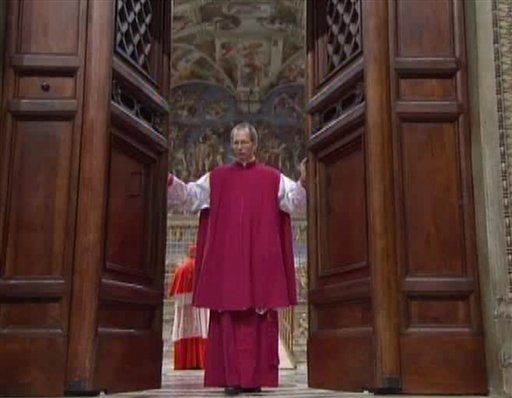
She swept past the guards into Saint Peter’s Basilica, and wandered the halls until she found the entrance the Sistine Chapel. There she knocked, and the Conclave’s doorman swung open the door.

Image

The Doors to the Conclave

From her came forth the words:

My Wisdom is a treasure unto men that never fails: which you Cardinals could use to become the friends of God, being commended for the gifts that come from learning. (b, Adopted from The Book of Wisdom or The Wisdom of Solomon)

From inside the 115 scarlet-robed Cardinals stared in shock at the woman standing outside the Chapel.  In unison, 115 voices bellowed:

No women allowed!

The doorman slammed the doors shut.

I love you,” replied God’s Wisdom.

But her voice was drowned out by the banging of the doors.

The next day, 115 men selected the next Pope—but the voice of God’s Wisdom was not heard.

(a)   Adopted from Proverbs 1: 20-21. See http://www.biblegateway.com/passage/?search=Proverbs%201:20-21&version=NRSV

(b)   Adopted from The Book of Wisdom or The Wisdom of Solomon. See http://ebible.org/kjv/Wisdom.htm and The Catholic Encyclopedia (http://www.newadvent.org/cathen/15666a.htm)

How are these concepts related?

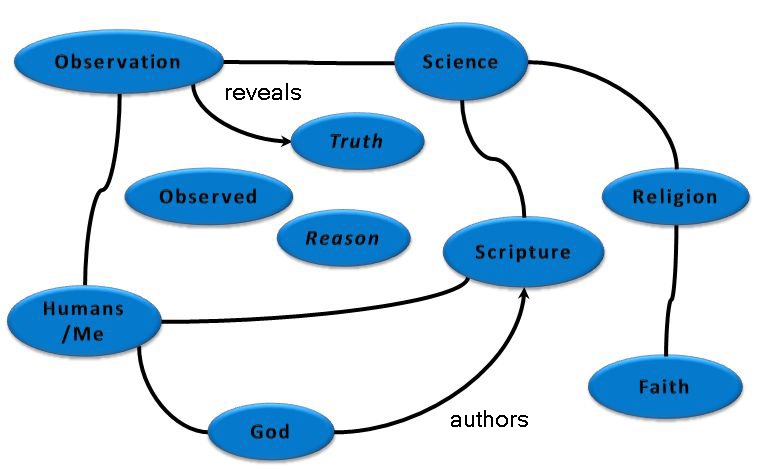
Study the set of concepts/objects in the figure. What relationship would you  assign them?

RelatedModels copyRelationships

Note that two of the relationships have been labeled, which provide examples of possible relationships.

The “God->authors->Scripture” is perhaps a common relationship for people of faith.

But what does this relationship imply?

It implies that God plays the role of author, which means that as author, God is in charge of making sure all the details are correct.

This implication has implications. If God is the author, has God checked that all the translations, like all the translations available through the pull down menu on Gateway Bible: http://www.biblegateway.com/passage/ :

The other labeled relationship, “Observation->reveals->Truth,” might be common sense for a person whose primary focus is science.  Here again, what does this relationship imply?

It begs the question of  “What is truth?”

Take a look at the figure “An examination of what is “real”  on blog “So what the heck is Model-based Reality (http://explorethegap.net/2012/03/29/so-what-the-heck-is-hawkings-model-dependent-realism-2/ )

You can see that this assumption is not so straight forward!

Reflection on this questions is, I maintain, our human search for meaning. Our labeling and defining these relationship is a life-long journey.

Tribes and Allies Gather to Protect the Sacred: the Environment

Tribes and Allies Gather to Protect the Sacred: the Environment

ACTION ALERT — January 21, 2013

Indigenous Nations from across the United States and Canada and their Allies will converge at the Yankton Sioux Reservation, South Dakota for a historical event, “Gathering to Protect the Sacred From the Tar Sands and Keystone XL.”  Taking place January 23rd-25th, 2013, this event will be held at the Ft. Randall Hotel and Casino, 38538 South Dakota Highway 46, Pickstown, SD, 57356.

Exploring the poison found between science, religion, and now politics

It is such a reoccurring theme as to be a candidate as a principle of “human psychological behavior.

I continually bring it to the attention of readers because it is so pervasive in all that we humans do. It goes like this:

People see in the information that which matches their model.

We see it again in Keith Kloor’s Discovery Magazine article “The Poisoned Debates between Science, Politics, and Religion.” Here is a link to the full article: http://blogs.discovermagazine.com/collideascape/2012/12/27/the-poisoned-debates-between-science-politics-and-religion/#.UPr3E6yKySpPoison

Keith cites multiple examples of how a group’s model of something, like  God, governance (played out in politics), or science causes people to see in the information, that which matches the  group’s model. This is perhaps a leading cause “poison” in human reasoning.

Being critical of activist atheists  Richard Dawkins and Jerry Coyne, Keith states that in their exuberant rejection of religion, they attend to only a narrow segment of the religious community and their behavior:

The other big argument waged by a vocal group of prominent scientists involves the assertion that science is incompatible with religion… What’s more, an argument that lumps together the Taliban, the Dali Lama, and Jesus strikes me as rather simplistic. The atheists who frequently disparage religion for all its faults don’t dare acknowledge that it has any redeeming value, or that it provides some meaning for those who can’t (or aren’t yet ready) to derive existential meaning from reason alone.

Keith goes on to report  the criticism of Peter Higgs:

What Dawkins does too often is to concentrate his attack on fundamentalists. But there are many believers who are just not fundamentalists. Fundamentalism is another problem. I mean, Dawkins in a way is almost a fundamentalist himself, of another kind.”

 Higgs points is pointing out here out that himself demonstrates the fundamentalist tenancies that  Dawkins is so critical of.

The fact that one recognizes and identifies this principle, does not give any leverage in escaloping the principle. That of course, applies to this author too.

Evidence that is can stand as a principle.

Astronomers Estimate That There at least 100 Billion Planets In the Galaxy

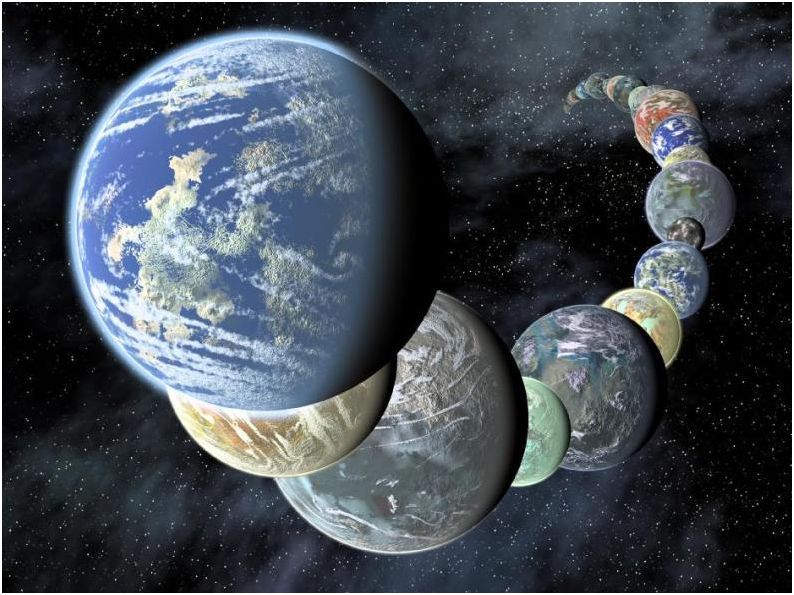
Science News article: Planets Abound: Astronomers Estimate That at Least 100 Billion Planets Populate the Galaxy

“There’s at least 100 billion planets in the galaxy — just our galaxy,” says John Johnson, assistant professor of planetary astronomy at Caltech and coauthor of the study, which was recently accepted for publication in the Astrophysical Journal. “That’s mind-boggling.”

From Science News Article:

http://www.sciencedaily.com/releases/2013/01/130103143422.htm?goback=.gmp_2074892.gde_2074892_member_201479279

This article  illustrates that the journey–and the scientific scenario–that Galileo helped kick off continues to this day. The scenario is as follows. When scientists put a device between themselves and that which is being observed it prompts an update in the models that make up a discipline of science.

PlanetEarthsMany

Picture Published in article

In the case of this article, the new measurement device is Kepler space telescope. Being is space, the telescope changes the perspective of the observation. The output of the device has a clarity that earth-based telescopes do not have.

When scientists make new observations and change models, it can cause “definitional dissonance” to some people. I saw an example of this in interesting factoid in the book “A Little History of Science” by William Bynum. In addition to upsetting the worldview held by the Catholic church, there was an even more basic reaction to the telescope itself. William reported  that people did not trust what was coming out of Galileo’s telescope.

They used denial as a means of alleviating their definitional dissonance.

But what this article illustrates the model of human behavior as “definers.” To view human knowledge without looking at all three elements–the observed, the observer, and the instruments used in the observation– one working with an incomplete model.

Understanding that this principle applies to two of human’s major efforts to understand the universe around us–science and religion–is vital when exploring the gap between the two.

So what the heck is Hawking’s “Model-dependent Realism?”

Stephan Hawking and Leonard Mldoinow describe what they term “model-dependent realism” in their book “The Grand Design.”

The cover of the The Grand Design"

The concept intrigues me. I find that their concept is similar to what I wrote about in the Chapter 3, “What do we know?” of Exploring the Gap between Science and Religion.

In this chapter expand and examine the “observer/observed” model, the basis of modern science. (Keep in mind that we are considered to be in the “post modern” science area.)

What I take from the model-dependent realism is that it takes in both the object being observed and the human-generated model resulting from our observations. I made this conclusion because of several statements about how specific capabilities of the observer alters the models that are a product of  the observations being made. Here is one such statement:

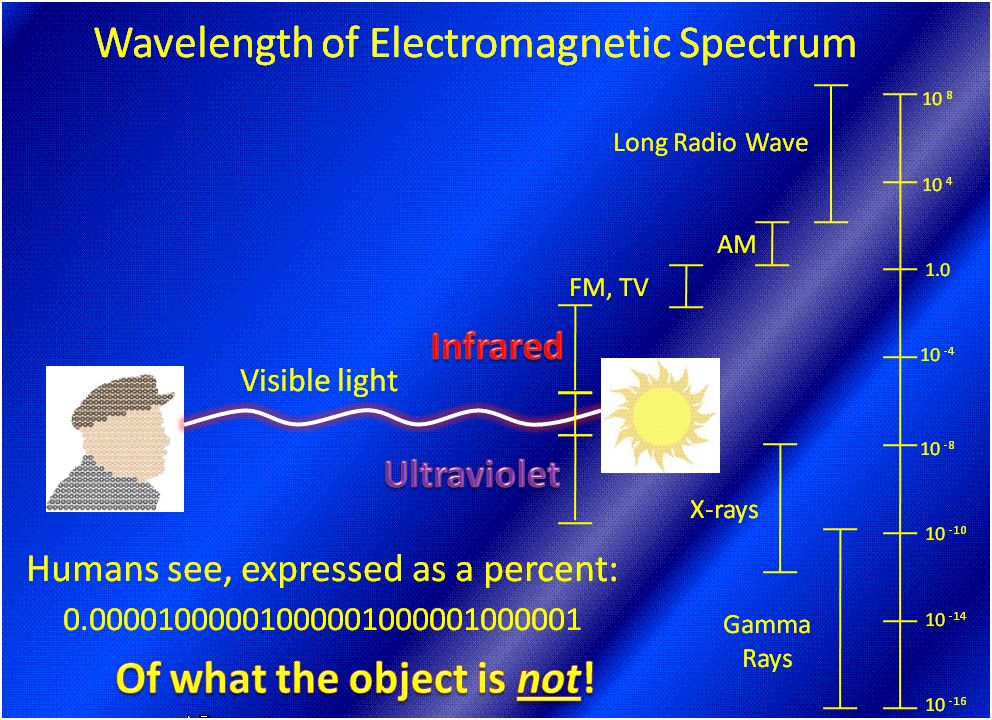
Our sun radiates all wavelengths, but its radiation is most intense in the wavelengths that are visible to us. It is probably no accident that the wavelengths we are able to see with the naked eye are those in which the sun radiates most strongly: It’s likely that our eyes evolved with the ability to detect electromagnetic radiation in that range precisely because that is the range of radiation most available to them. (The Grand Design, Page 91)

It goes on to speculate about life forms living within the range a different source of energy source would most likely develop different perception capabilities. Figure 4 of theExploring the Gap”illustrates the relationship between human perception and the electromagnetic spectrum:

The human eye preceives a small percentage of the total electromagnetic spectrum.

An examination of what is “real”

In the following statement Hawkings and Mldoinow describe how model-dependent realism causes us to rethink what is “rea,l” and the role of observation:

Model-dependent realism short-circuits all the arguments and discussion between the realist and the anti-realist schools of thought. According to model-dependent realism, it is pointless to ask whether a model is real, only whether it agrees with observation. If there are two models that agree with observation, like the goldfish’s picture and ours, then one cannot say that was is more real than another. (The Grand Design, Page 45-46)

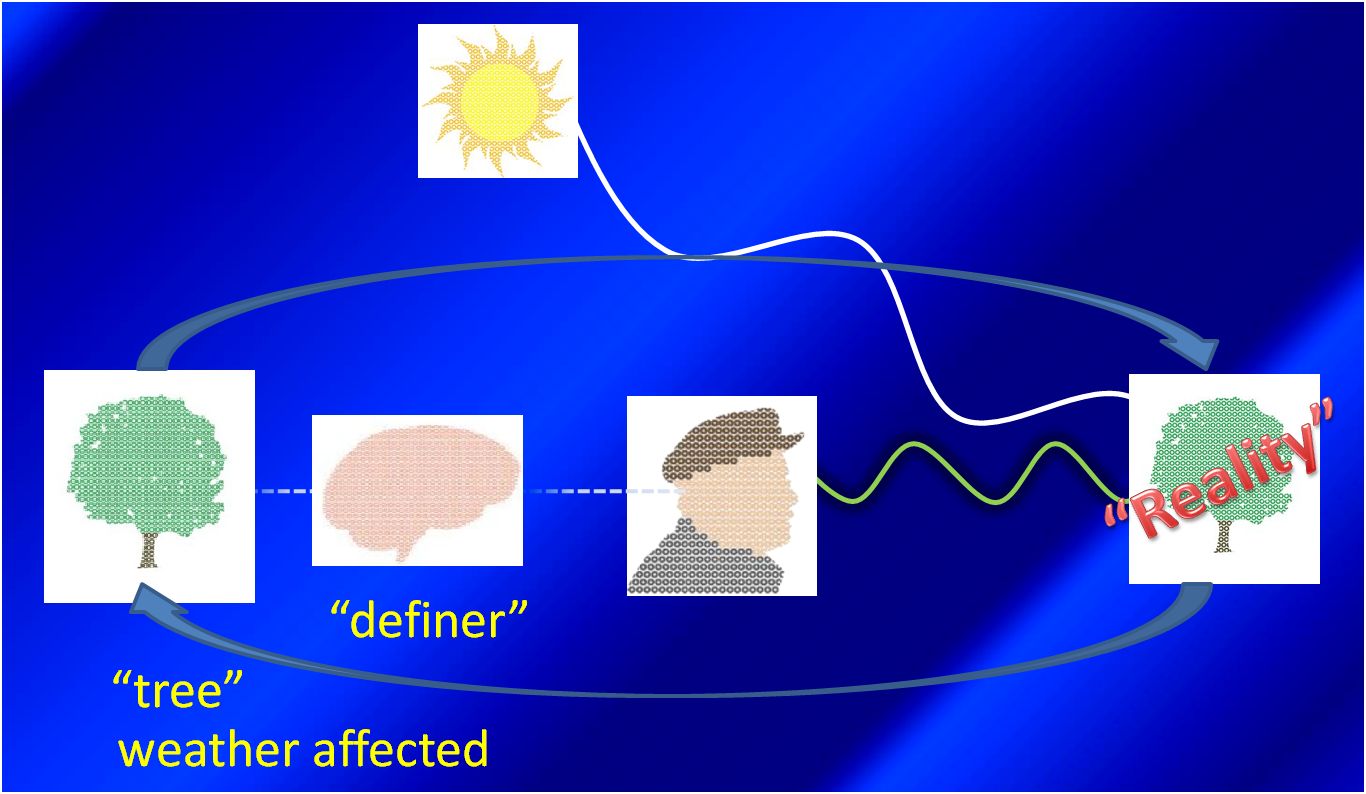
This diagram provides a graphic representation of model-dependent realism within context of a model of a human observation. It comes from Chapter 3.

A tree on the right, and a representation on the left

When discussing “Exploring the Gap between Science and Religion” I sometimes ask the audience: “What is the philosophical implication of this picture?”

The answer is that there are two trees in the picture: 1) the one that is subject of the observation and 2) the model that our mind creates as a result. The curved arrows represent our on-going observations, which over time cause us to update our model. In this particular example, I point out that when a tree loses its leaves during the winter, we must update our model. The update reflects that our model of the tree is linked the model temperature and seasons.

Which leads us to another insight from The Grand Design. Hawkings and Mlodinow allude to an interlinking of models (theories) in the following statement:

Each theory in the M-theory network is good at describing the phenomena within a certain range. Whenever their ranges overlap, the various theories in the network agree, so they can all be said parts of the same theory. But no single theory within the network can describe every aspect of the universe–all the forces of nature, the particles that feel those forces, and the framework of space and time in which it all plays out.

The “M-theory” network they are talking about is an extension of string theory, so their focus is narrower than mine. I submit that there is wisdom to be gained by their statement that “no single theory” … “can describe every aspect of the universe” when we develop our personal worldviews in this post-modern world.

A 2012 Look at the story of The Rich Young Ruler

A key insight one discovers when exploring the gap between science and religion is the role of “anomalies,” which are inconsistencies or contradictions between something we observe (including reading) and the model or models we develop as a result.

We encounter these anomalies in almost all human endeavor, including science, religious beliefs, and politics.

The story below from the Christian New Testament book of Matthew 19: 13-22 highlights a stark anomaly being played out on the American political stage.

This is a 2012 rendition of “The Rich Young Ruler.” The bold characters identify where the story has been updated to connect it the context in which Americans find themselves.

The Rich Young Ruler

16Just then presidential candidate Mitt Romney came up and asked Jesus,(M) “Teacher, what good must I do to have eternal life?”(N)

17 “Why do you ask Me about what is good?”[f] Jesus said to Mitt. “There is only One who is good.[g] If you want to enter into life, keep the commandments.”(O)

18 “Which ones?” Mitt asked Him. Jesus answered:

Do not murder;
do not commit adultery;
do not steal;
do not bear false witness;(P)
19 honor your father and your mother;
and love your neighbor as yourself.(Q)[h]

20 “I have kept all these,”[i] Mitt told Him. “What do I still lack?”

21 “If you want to be perfect,”[j] Jesus said to him, “go, sell your belongings and give to the poor,(R) and you will have treasure in heaven. Then come, follow Me.”

22 When Mitt heard that command, Mitt stated his political position by saying, “I’m not concerned about the very poor—we have a safety net there. If it needs repair, I’ll fix it. I’m not concerned about the very rich, they’re doing just fine. (See http://www.politico.com/news/stories/0212/72297.html and or Google “Mitt Romney “I’m not concerned”)

And he went away grieving, because he had many possessions.

By replacing the “rich young ruler” with a living a 21st century politician we can examine and compare two contexts. It is here that we find the anomalies between the two contexts. The first context is the spiritual and values context of scripture, and second is the economic / political context in which American voters find themselves.

Placing these two contexts together quickly highlights a host of contradictions related to how we define (aka model) God, Jesus, religion, and living a life according to principles and the values as taught by Jesus himself.

After this story, Jesus teaches his disciples the meaning of the conversation between himself and the rich young ruler. Here is the wisdom that Jesus shares, which is Matthew 23-26.

Possessions and the Kingdom

23 Then Jesus said to His disciples, “I assure you: It will be hard for a rich person to enter the kingdom of heaven!(S) 24 Again I tell you, it is easier for a camel to go through the eye of a needle than for a rich person to enter the kingdom of God.”(T)

25 When the disciples heard this, they were utterly astonished and asked, “Then who can be saved?”

26 But Jesus looked at them and said, “With men this is impossible, but with God all things are possible.”(U)

To read the original from the “Holman Christian Standard Bible” following this link: http://www.biblegateway.com/passage/?search=Matthew%2019:16-26&version=HCSB

It is interesting to consider Mitt Romney’s statements about his priorities related to the rich and the poor, given God’s wisdom as spoken by Jesus.

Like I stated in the opening, a key insight one discovers when exploring the gap between science and religion is the role of “anomalies.” Discussions and dialogs about those anomalies provide those seeking to discover truth opportunities to examine what anomalies that each of us carries around within us.

Neutrinos to Audition for “The Universe has Talent” Competition

Neutrino Detector, Wikipedia

Those Pesky Neutrinos!  They are making a bid for a spot on the Galaxies’ “The Universe has Talent” reality show! Or are they vying for a Ripley record for “Universe’s fastest subatomic particle?”

Don’t they know that their need for speed is wreaking havoc in the physics world? Don’t they know they are challenging the infallibility of the physicist’s sacred scripture: the Standard Model?!

Yes. I’m being tongue-in-cheek. And yes, I know I am stretching it just a little when I compare the Standard Model to religious scripture.

Yet I submit to you that we can gain profound insight by doing just that.

Let me explain!

When news from CERN regarding the speed demon neutrinos hit the mainstream news, it reminded me of a conversation had some 33 years ago.

I had just graduated from college with a degree in Philosophy. Having discovered that there were no in-house philosophy positions, I opted for the next best thing: making my living by counting men’s underwear at a major department store.

There I became friends with a fellow employee who was a seminary student working his way through school as the department store’s suit salesman.

One Friday evening Bill (I really don’t remember his name) came up to me and with excitement in his voice made the follow claim:

I have the proof of the existence of God!

Needless to say, as a philosophy major I was intrigued!

His claim went something like this, “Einstein’s physics proves that nothing can go faster than the speed of light. This means that that there is an absolute in the universe! Since an absolute exists—and God is absolute—God exists.”

Think about his claim given the results reported by the CERN laboratory! If Bill continued to subscribe to this “proof” of the existence of God, he no doubt finds the claims from CERN a challenge to his “proof-based” paradigm of God (aka Faith).

Now imagine with me a minute that he finished his studies in the seminary and became a minister. In this leadership role he has taught members of his church to base their faith in God on this “absolute” regarding the speed of light. Had this happened, a whole community could now be facing the following dilemma: to either deny the results of the CERN experiment (at the very least hope that CERN is wrong) or to update their model that God’s existence is linked to the inability of things to move faster than the speed of light.

Members of our hapless—and imaginary— “faith community” are not the only ones faced with this “either/or” choice. Scientists subscribing to physics’ Standard Model find themselves in the proverbial “same boat.”

“Oh really?” you may be asking. We see evidence of this from the science community where we find their initial skepticism to the neutrino’s bid in the following statement:

In fact, the result would be so revolutionary that it’s sure to be met with skepticism all over the world. (1)

That skepticism is natural, and I maintain is “humanly natural.” It reflects the discipline’s investment in the current Standard Model (aka paradigm), and an understanding of the “costs” involved in updating it.

Drawing from Thomas’ Kuhn’s The Structure of Scientific Revolutions, I submit that what we see at play in both the physicists and the faith community is a propensity to discount data that is an anomaly to the model. With just a little digging into neutrino story one can find evidence of efforts to discount data. You see, the neutrinos have been telling their story of a lot longer than reported to the general public.

This isn’t an isolated anomaly, but has been going on for years. The team has now measured some 15,000 batches of neutrinos coming across that distance, and they say they’ve reached a point where the statistical significance is such that, were they trying to prove anything else, it would count as as formal scientific discovery. But try as they might, they can’t explain what’s happening. (2)

Additional evidence of science’s discounting of data can be found in the case of the 1987a supernova:

The MINOS experiment a few years back already found evidence that neutrinos might move faster than the speed of light c, namely at 1.000051 (+/- 0.000029) c. Supernova1987A in the Large Magellanic Cloud 168 thousand light-years away indicated at most a tiny increase over the speed of light. 23 neutrinos were seen over 13 seconds arriving 3 hours earlier than the light. (3)

Let me conclude summarizing how both groups are handling the news about the speedy neutrinos. Both based their model / paradigm / worldview on a previous, human created model / paradigm / worldview. When faced with observational anomalies (the CERN results), we humans also draw from our human nature as “definers.” In fact, we cannot escape it. And as a result, they will forever wrestle with the question:

Shall I live in the past with models that are now inadequate to account for all observations, or do I accept the challenge of moving on?

(1)    Science Now, “Neutrinos Travel Faster than Light, According to One Experiment

(2)    POPSCI, “Baffling CERN Results Show Neutrinos Moving Faster than the Speed of Light

(3)    Science 2.0, “A Million Times The Speed Of Light

The Truth Wears Off?

Many results that are rigorously proved and accepted start shrinking in later studies. (Credit: The New Yorker)

In a recent seminar that I was giving, a professor and scientist in the audience was offended when a slide I was showing stated that people will ignore data/information that does not match their model. He asked me if I was implying the scientists ignore data.

He went on to tell me that he would get fired in his job if he did that, and that a scientist would “never ignore data.”

I was intrigued by how strongly he reacted, but decided that it enough off topic to not pursue it.

And now I run into this interesting “The Truth wears off” article published in “The New Yorker.”

Here is an except from the article:

But now all sorts of well-established, multiply confirmed findings have started to look increasingly uncertain. It’s as if our facts were losing their truth: claims that have been enshrined in textbooks are suddenly unprovable. This phenomenon doesn’t yet have an official name, but it’s occurring across a wide range of fields, from psychology to ecology. In the field of medicine, the phenomenon seems extremely widespread, affecting not only antipsychotics but also therapies ranging from cardiac stents to Vitamin E and antidepressants.

Click here to read the entire article.

How does one explain such phenomena? Does this support my premise about seeing in the data what matches our model? It sure is one explanation!

The other issue that the article raises is the unstated assumption, which is another topic touched upon in “Exploring the Gap between Science and Religion.”  And that is what is the nature of truth, and does science deal with truth in the fist place.  This question is posed by the blog: “What is the nature of truth? Is it self-evident?”

Woman by the Window

by Lee Wimberly
Photo by Jerry Gay, published in “Seeing Reality.

Is she happy? Can she walk? What is the color of her dress?

I “see” you, pictured by the window,
wheelchair-bound, neck stretched and smiling.
But do I see YOUR picture?

I “see” you, a gift given by light entering window,
softened by curtain-filters to lightly paint your face,
and dress,
and arms,
and hands.
With illumination my near-sighted and
light-ray limited orbs so demand.
So they can surface connect,
fulfilling their separation-saturating role.
That I might recognize your surface, but get not a glimpse of your soul.

Yet I sense so much more than the shades of gray
given me by photographer and binding and book and paper.
How reach you out to me from flattened surface;
past eyes and nerves and brain and self-imposed words?
Past veins and arteries, through blood, past muscle,
to mysteriously move my very heart and Essence?

Let Us not, you and me and listener and onlooker,
remain caught at the superficial veneer we hide
behind to protect that fragile, self-absorbed ego.
But let us instead stand up from our wheel-chair prisons
to reach ahead of separating time and past distancing space.
Let us bask in warm glow of your projected joy,
to go beyond your camera-captured “now.”
Share with us your vibrant spirit and teach us your unspoken,
heart-earned life-lessons in the non-terms of Unifying Spirit.

Let us reach out and touch each other in ways
only understood by Creator. Let the Us we are
collapse the space-time and camera-filtering chasm
that disconnect us and go beyond our limited knowing,
to experience not that which splits us, and deceives us to be
single threads, but instead to comprehend the interwoven strands of
God-space and God-time and God-universe.
And may we gaze past that which we so easily label reality,
to experience and know the Divine.

Background: The poem “Woman by the Window” is my response to Jerry Gay’s photo, which I in turn became familiar with because of Jerry’s photography book “Seeing Reality.”

The picture and photo gives expression to the existential elements behind “Exploring the Gap between Science and Religion.”