Stephan Hawking and Leonard Mldoinow describe what they term “model-dependent realism” in their book “The Grand Design.”

The concept intrigues me. I find that their concept is similar to what I wrote about in the Chapter 3, “What do we know?” of Exploring the Gap between Science and Religion.
In this chapter expand and examine the “observer/observed” model, the basis of modern science. (Keep in mind that we are considered to be in the “post modern” science area.)
What I take from the model-dependent realism is that it takes in both the object being observed and the human-generated model resulting from our observations. I made this conclusion because of several statements about how specific capabilities of the observer alters the models that are a product of the observations being made. Here is one such statement:
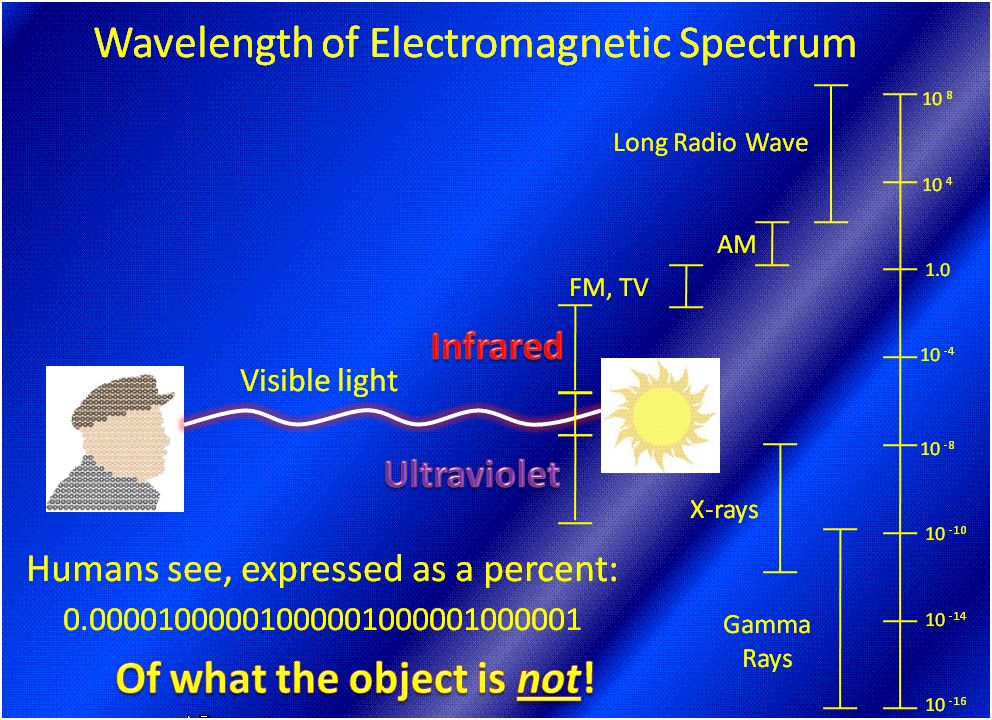
Our sun radiates all wavelengths, but its radiation is most intense in the wavelengths that are visible to us. It is probably no accident that the wavelengths we are able to see with the naked eye are those in which the sun radiates most strongly: It’s likely that our eyes evolved with the ability to detect electromagnetic radiation in that range precisely because that is the range of radiation most available to them. (The Grand Design, Page 91)
It goes on to speculate about life forms living within the range a different source of energy source would most likely develop different perception capabilities. Figure 4 of theExploring the Gap”illustrates the relationship between human perception and the electromagnetic spectrum:
An examination of what is “real”
In the following statement Hawkings and Mldoinow describe how model-dependent realism causes us to rethink what is “rea,l” and the role of observation:
Model-dependent realism short-circuits all the arguments and discussion between the realist and the anti-realist schools of thought. According to model-dependent realism, it is pointless to ask whether a model is real, only whether it agrees with observation. If there are two models that agree with observation, like the goldfish’s picture and ours, then one cannot say that was is more real than another. (The Grand Design, Page 45-46)
This diagram provides a graphic representation of model-dependent realism within context of a model of a human observation. It comes from Chapter 3.
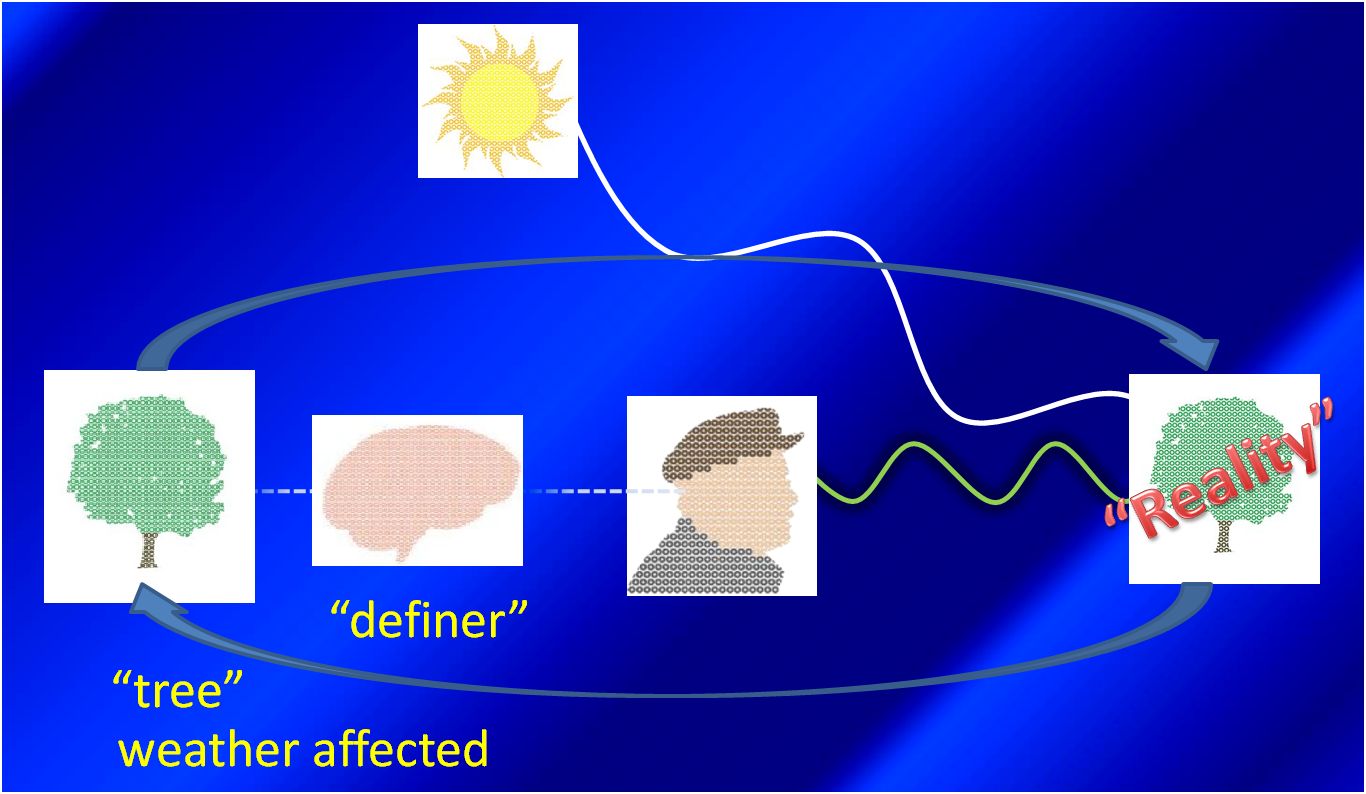
When discussing “Exploring the Gap between Science and Religion” I sometimes ask the audience: “What is the philosophical implication of this picture?”
The answer is that there are two trees in the picture: 1) the one that is subject of the observation and 2) the model that our mind creates as a result. The curved arrows represent our on-going observations, which over time cause us to update our model. In this particular example, I point out that when a tree loses its leaves during the winter, we must update our model. The update reflects that our model of the tree is linked the model temperature and seasons.
Which leads us to another insight from The Grand Design. Hawkings and Mlodinow allude to an interlinking of models (theories) in the following statement:
Each theory in the M-theory network is good at describing the phenomena within a certain range. Whenever their ranges overlap, the various theories in the network agree, so they can all be said parts of the same theory. But no single theory within the network can describe every aspect of the universe–all the forces of nature, the particles that feel those forces, and the framework of space and time in which it all plays out.
The “M-theory” network they are talking about is an extension of string theory, so their focus is narrower than mine. I submit that there is wisdom to be gained by their statement that “no single theory” … “can describe every aspect of the universe” when we develop our personal worldviews in this post-modern world.