Taking The Quantum Leap into A History of God

I recently read two books in parallel:  Taking the Quantum Leap by Fred Alan Wolf and A History of God by Karen Armstrong.
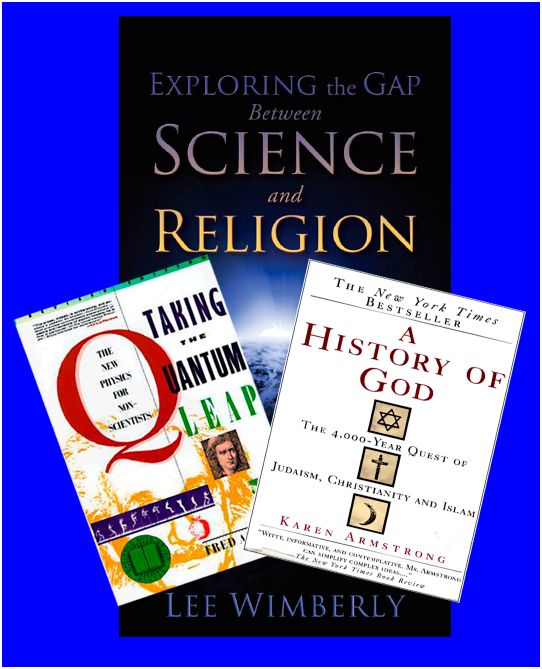
Three book covers

Taking the Quantum Leap and A History of God viewed through the perspective of Exploring the Gap between Science and Religion.

My goal in reading them in parallel was to find common threads between these books and the concepts presented in Exploring the Gap between Science and Religion.   

The most intriguing insight was a single Biblical reference found in all three book. It is the story of Moses and the burning bush found in Exodus, Chapter 3, verses 13 and 14:

Moses said to God, “Suppose I go to the Israelites and say to them, ‘The God of your fathers has sent me to you,’ and they ask me, ‘What is his name?’ Then what shall I tell them?”

God said to Moses, “I am who I am. This is what you are to say to the Israelites: ‘I am has sent me to you.’” (a)

In Exploring the Gap I refer God’s “I am” statement as one of  six Biblical stories that are “Themes of Unity in the Christian Bible.” (b)  Regretfully, I did not expand on that topic as much as I would have liked.

In A History of God Karen Armstrong states the following:

Instead of revealing his name directly, he answers “I am Who I Am (Ebyeh asber ebyeh) …(c)

There was to be no discussion of God’s nature and certainly no attempt to manipulate him as pagans sometimes did when they recited the name s of their gods. Yahweh is the Unconditional One: I shall be that which I shall be. (d)

In Taking the Quantum Leap, Wolf states the following regarding Moses’ experience with the burning bush:

The first documented case of quantum consciousness may have been Moses. When he asked “Who are you?” of the Presence felt at the burning bush, the answer came “I AM THAT I AM.” Moses then recognized that, within him, the God Voice now spoke as Moses.

(a) BibleGateway.com, http://www.biblegateway.com/passage/?search=Exodus%203:13-14&version=NIV

(b) Exploring the Gap between Science and Religion, Book Publishers Network, 2011, p. 66. Note: the underline added by me.

(c) A History of God, Ballentine Books, New York, 1993, p. 21

(d) A History of God, Ballentine Books, New York, 1993, p. 22

(e) Taking the Quantum Leap, Harper & Row, New York, 1989
The question: “DO YOU BELIEVE IN Apes MAN – Man was a Monkey?

The question “DO YOU BELIEVE IN Apes MAN – Man was a Monkey?” caught my attention. It was obviously asking about the reader’s position regarding biological Evolution, and most likely as it related to Creationism.

I found this question posed on a LinkedIn group called “New Philosophy Network.” It was submitted by a a teacher at King Saud University in Saudi Arabia. In his opening argument he states “I reject this fallacy that We develop From the Animal Kingdom, monkey to human?”

I found the question and subsequent dialog intriguing because the whole “creation versus evolution” has been the hottest topics related to the relationship between science and religion.

AN EVOLUTIONIST WOULD AGREE

I submit that an evolutionist fully would agree that he or she also does not believe that people evolved from monkeys!

I state this for two reasons.

First, the model that we know as evolution is not based on belief. It is based instead on observations made by biologists and geneticists. This body of detailed recorded observation spans several hundred—no several thousand—years. The resulting biological model has evolved, ever changing as new observations make previous models obsolete.

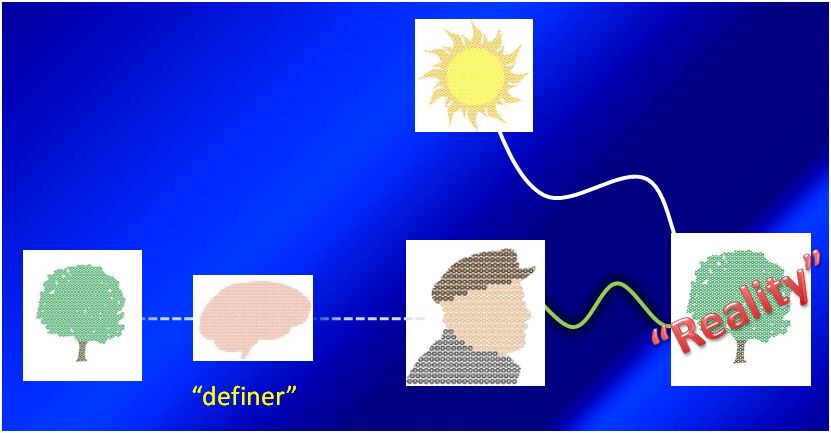
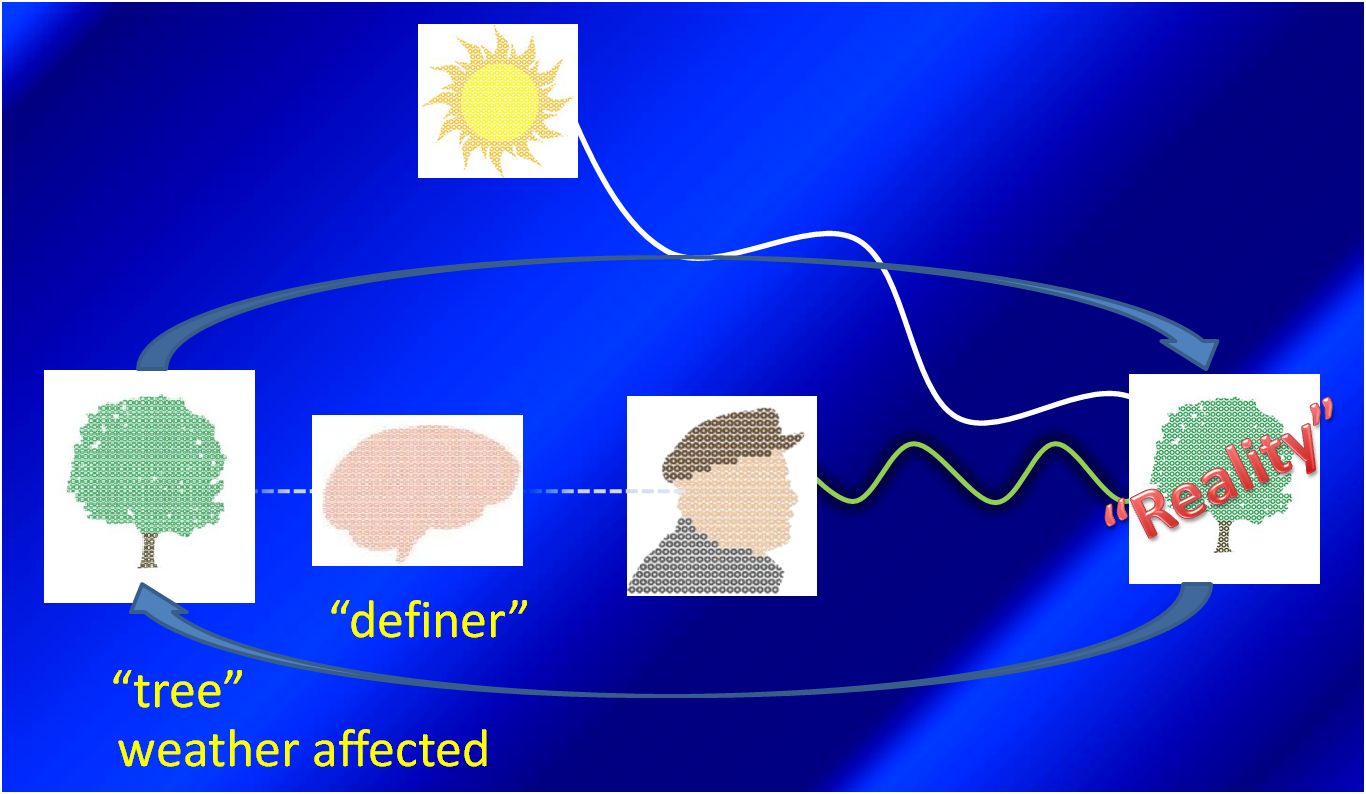
This process is illustrated in this simple model of someone observing a tree.

The model is based on observation.

From these observations, the discipline known as evolutionary biologists has built a detailed set of interlocking models that represents the content of their body of observations. These models include genetics, physical characteristics, and the environment to name a few.

Not being a trained biologist, I must admit that I am not qualified to critique the details of their various models.  What I do know is that the cornerstone of science is verification, a process that works to ensure that the observations and as much as possible are objective.

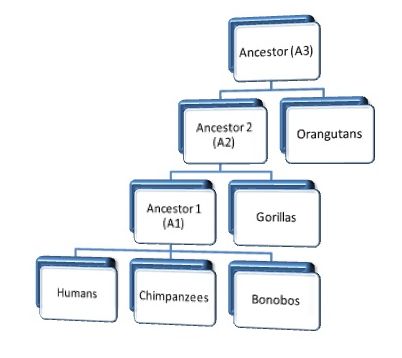
Second, as the evolutionary model currently stands, humans, apes, and monkeys share a common ancestor. Here is a representation of the common ancestor to apes, monkeys, and people. So no. Humans have not evolved from monkeys, at least as the evolutionary model stands today. Here is a graph showing how we share a common ancestor.

Graph depicting common ancestor

Graph of common ancestors (1)

Let me submit that the author is posing the wrong—and irrelevant—question.

A person of faith should be asking, “Is my relationship with Divine is so tenuous that a human model of the universe, such as the earth rotating around the sun or a biologist’s representation of animal genealogy, challenges that relationship?”

(1) “Why We Did Not Evolve from Monkeys: Human Common Ancestry Explained,”  by ConnorDavidson http://searchwarp.com/swa840509-Why-We-Didnt-Evolve-From-Monkeys-Human-Common-Ancestry-Explained.htm

Galileo’s Hammer: The Telescope

When Galileo put a telescope between himself and universe, he changed everything!

Well. Not really everything!

What he did was knock a crack in a long-held conceptual wall. It was a wall designed by philosophers Plato and Aristotle, and constructed  by the Western branch of the Christian church. (1)

His simple telescope (which had the magnification of a normal pair of binoculars) gave him more detailed observations than he could get from the naked eye.

His telescope revealed the Milky Way, which appears wonderful fuzzy blur of light when looking with the naked eye on a  clear night, was actually composed of thousands and thousands of individual stars, very far away from earth.” (2)

EarthsLocationInTheMilkyWay

Our Place in the Milky Way

Skeptics didn’t trust either the instrument  nor the models he built based his observations.

Each revelation called into question what people thought about the heavens. Some thought Galileo’s ideas were based on tricks played by his new ‘tube’, as the telescope was often called, because what could not be seen by the naked eye might not be there. Galileo had to try to convince people that what his telescope showed was real.” (3)

Galileo’s story is the classic example of the competition between science and religion. A competition for the dominance in worldviews.

Ultimately this simple telescope of his became the hammer that cracked the rigid wall of religion. The crack initially created by Galileo has become a continuous and growing breech. With each new cycle of observation, improved measuring instruments, and updated models, new anomalies arise between science’s insights and the remnants of  religion’s crumbling wall.

Religions either address these anomalies, or fade into irrelevancy.

The Hubble Telescope Blasts Away at the Wall?

In the tradition the telescope, The Hubble Telescope continues to reveal challenging  information. This challenge is for both science and religion, but the very structure of science makes it more flexible when encountering this new information.

“Since the earliest days of astronomy, since the time of Galileo, astronomers have shared a single goal — to see more, see farther, see deeper.

The Hubble Space Telescope’s launch in 1990 sped humanity to one of its greatest advances in that journey.”(4)

3DMapofUniverse

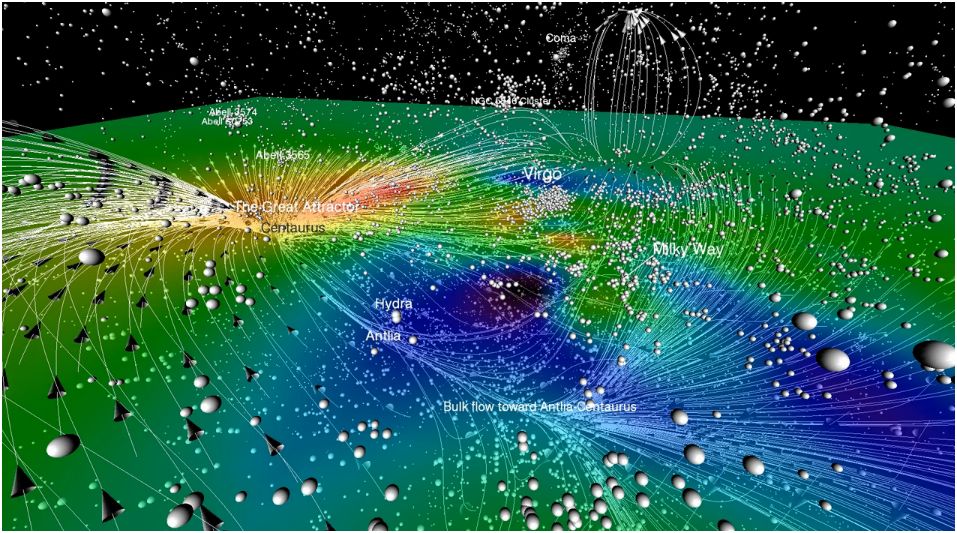
A Snapshot of the 3D Model of the Universe (5)

With it’s less obstructed view of the universe, today’s astronomer’s have been able to construct an amazing  3D map of universe. (6)

The creator of the 3D map of the universe–Brent Tully–followed in Galileo’s footsteps when he created this detailed model of the universe. One feels a sense of awe and wonderment at the vastness shown by the map.

And frankly, it blasts away at what remains of religion’s conceptual wall. To take the challenge, watch the video: http://irfu.cea.fr/cosmography

(1) Exploring the Gap between Science and Religion, Chapter Six: “Shall I Worship the God I Create or the God that Created Me”, p. 42, Figure 12 — Contributors to the Western God Model.

(2) “A Little History of Science, p 65.

(3) Ibid, p 65.

(4) “Hubble Site,” “Hubble Essentials.” http://hubblesite.org/the_telescope/hubble_essentials/

(5) Picture taken from the video walk-through of the 3D Model, http://irfu.cea.fr/cosmography

(6) Discover Magazine “The Most Map You’ll See Today,” http://blogs.discovermagazine.com/outthere/2013/06/16/the-most-amazing-map-youll-see-today-no-matter-what-day-it-is/#.UcoTLTuThyL

There are Always Two trees…and Two Gods

An insight one discovers when exploring the gap between science and religion is that there are always two “somethings!”

There is the object “out there” which is the subject of an individual’s observation, and there is the representation of that object in that humans as “definers” create.

There is a bark-encased, branch-spreading, leaf-bearing (or needle bearing) object, and then there is the representation of that something that we have in our minds. It is of course, the tree. This representation is so pervasive, we almost never attend to it.

Trees. Two of them. The one on the right the one outside of us. The one on the left, our model.

Note the philosophical insight: there are two trees.

This “twoness” is not so clear when it comes to intangible “things,” such as love, smell, and transcendental object humans label as “God.”

The labeling of something as “god” or “God” is not limited to those who believe in God. Atheists have a model of god, to which they attribute the characteristic of “non-existent.”

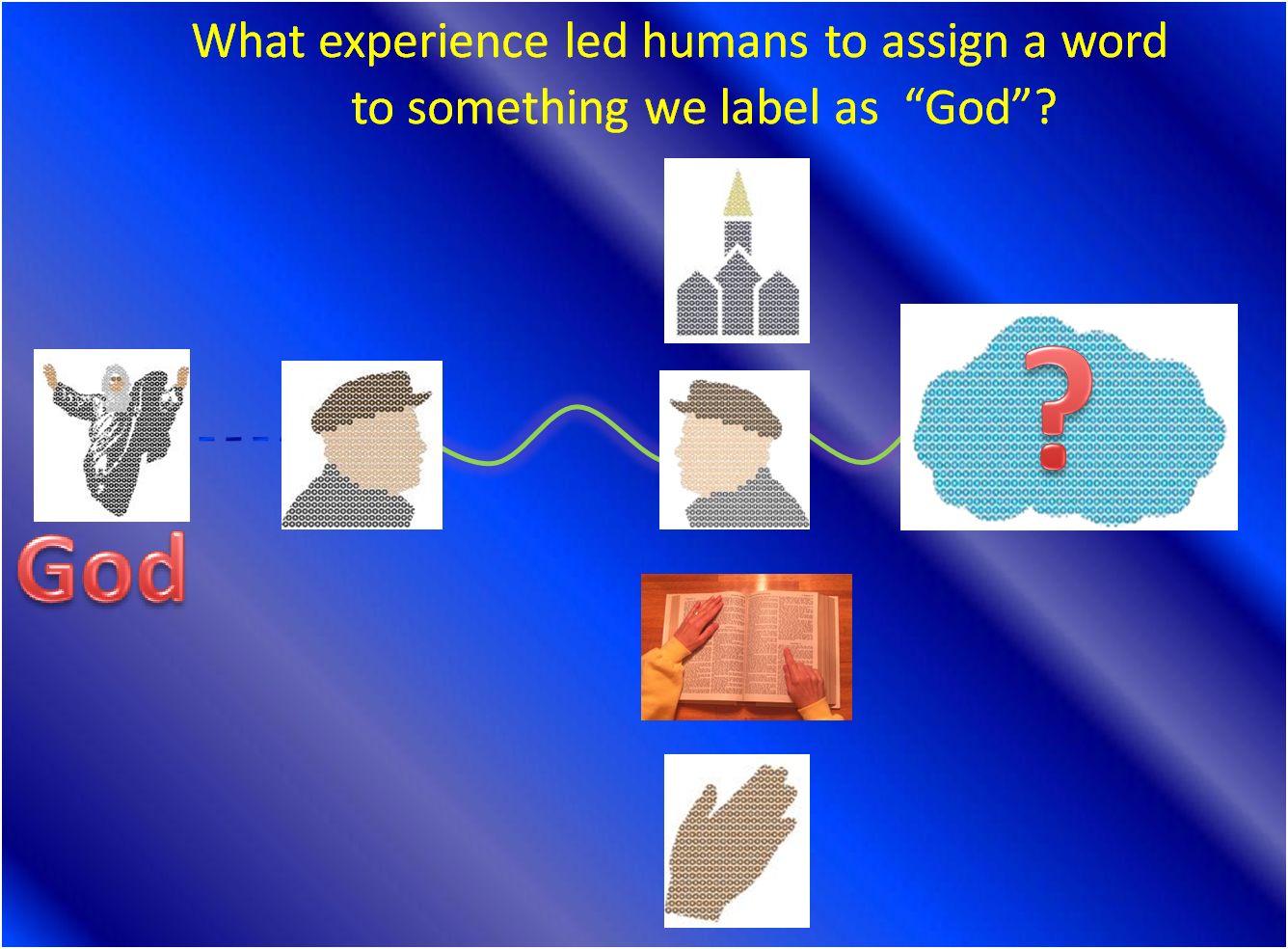
Whether one is an atheist or a theist, the fact that humans created of the term and concept that deals with the transcendental raises the question, “What experience has led humans to label something as “God.”

UniversalSenseOfTheBehond

An experience of something bigger than oneself…

Perhaps it is what Sociologists report as a universal experience of something bigger than ourselves–aka transcendental. “Universal” in this case refers to a global phenomena where every culture has those in their society who testify to this experience.

From this experience of the transcendental–that which transcends the individual (aka ego)–we humans have modeled this experience is different ways. For example, eastern philosophy’s representation as Nirvana and/or the opening lotus blossom.

Notice that in next graphic, the Abrahamic religion’s representation of God as a old male with a long beard and flowing robes. That representation is shaped by other people, the prevailing culture, scripture & other written works, and prayer & meditation.

TheGodHumansCreated

A god created by humans, is a representation of “something?”

For people who have a strong religious sense then, the challenging question becomes:

Whom shall I worship? The god I created, or the God that created me?

The next logical question is:

How do I know which one?

A Modern Parable

A Parable for Our Times

The parable is a powerful means of conveying truth and insight. As a tool for teaching, it draws the reader’s attention to contradictions and inconsistencies in cherished belief systems and pet theories. As a story, it causes the reader to see how actions that might otherwise appear to be perfectly reasonable are actually illogical.

Parable as a literary form and teaching format conveys insights, but is rightfully outside of science’s wheel house.

Even so, a person whose primary focus is science can appreciate the profound truths gained through a parable. So the following story, posted within a science and religion dialog, invites us to distinguish between the literal truth of science and the metaphorical truth told through a mythical character.

God’s Wisdom Knocks, the Parable

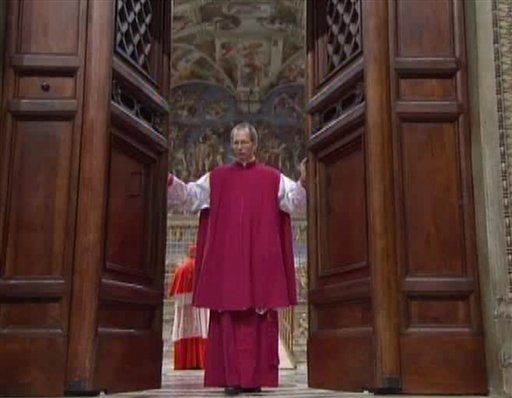
The 2013 Catholic Conclave closed its doors to begin their election of the new Pope.  As the doors closed, the faithful around the world prayed for God’s Wisdom in selecting the next pope.

Having heard the prayers, God’s Wisdom, Sophia…

Cried out in the street;
In Saint Peter’s Square she raised her voice.
At the busiest cobble-stoned street corner she cried out;
At the entrance the gates of Vatican City she spoke:
How long will you who are simple love your simple ways?
    How long will mockers delight in mockery
    and fools hate knowledge?  (a. Adopted from Proverbs 1: 20-21.)

She swept past the guards into Saint Peter’s Basilica, and wandered the halls until she found the entrance the Sistine Chapel. There she knocked, and the Conclave’s doorman swung open the door.

Image

The Doors to the Conclave

From her came forth the words:

My Wisdom is a treasure unto men that never fails: which you Cardinals could use to become the friends of God, being commended for the gifts that come from learning. (b, Adopted from The Book of Wisdom or The Wisdom of Solomon)

From inside the 115 scarlet-robed Cardinals stared in shock at the woman standing outside the Chapel.  In unison, 115 voices bellowed:

No women allowed!

The doorman slammed the doors shut.

I love you,” replied God’s Wisdom.

But her voice was drowned out by the banging of the doors.

The next day, 115 men selected the next Pope—but the voice of God’s Wisdom was not heard.

(a)   Adopted from Proverbs 1: 20-21. See http://www.biblegateway.com/passage/?search=Proverbs%201:20-21&version=NRSV

(b)   Adopted from The Book of Wisdom or The Wisdom of Solomon. See http://ebible.org/kjv/Wisdom.htm and The Catholic Encyclopedia (http://www.newadvent.org/cathen/15666a.htm)

How are these concepts related?

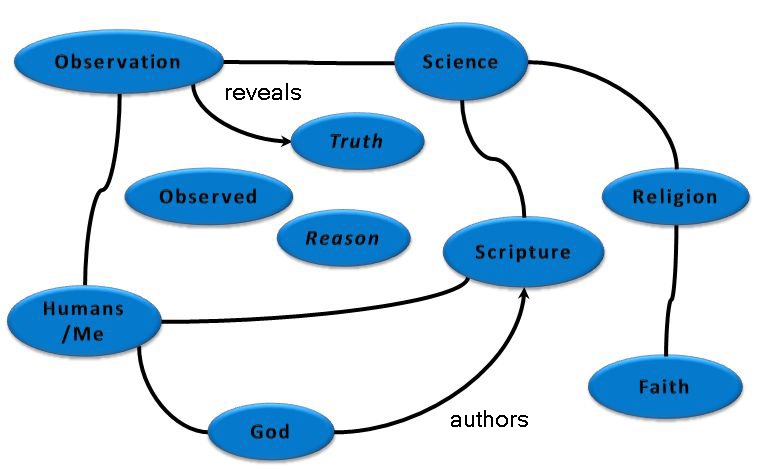
Study the set of concepts/objects in the figure. What relationship would you  assign them?

RelatedModels copyRelationships

Note that two of the relationships have been labeled, which provide examples of possible relationships.

The “God->authors->Scripture” is perhaps a common relationship for people of faith.

But what does this relationship imply?

It implies that God plays the role of author, which means that as author, God is in charge of making sure all the details are correct.

This implication has implications. If God is the author, has God checked that all the translations, like all the translations available through the pull down menu on Gateway Bible: http://www.biblegateway.com/passage/ :

The other labeled relationship, “Observation->reveals->Truth,” might be common sense for a person whose primary focus is science.  Here again, what does this relationship imply?

It begs the question of  “What is truth?”

Take a look at the figure “An examination of what is “real”  on blog “So what the heck is Model-based Reality (http://explorethegap.net/2012/03/29/so-what-the-heck-is-hawkings-model-dependent-realism-2/ )

You can see that this assumption is not so straight forward!

Reflection on this questions is, I maintain, our human search for meaning. Our labeling and defining these relationship is a life-long journey.

Tribes and Allies Gather to Protect the Sacred: the Environment

Tribes and Allies Gather to Protect the Sacred: the Environment

ACTION ALERT — January 21, 2013

Indigenous Nations from across the United States and Canada and their Allies will converge at the Yankton Sioux Reservation, South Dakota for a historical event, “Gathering to Protect the Sacred From the Tar Sands and Keystone XL.”  Taking place January 23rd-25th, 2013, this event will be held at the Ft. Randall Hotel and Casino, 38538 South Dakota Highway 46, Pickstown, SD, 57356.

Exploring the poison found between science, religion, and now politics

It is such a reoccurring theme as to be a candidate as a principle of “human psychological behavior.

I continually bring it to the attention of readers because it is so pervasive in all that we humans do. It goes like this:

People see in the information that which matches their model.

We see it again in Keith Kloor’s Discovery Magazine article “The Poisoned Debates between Science, Politics, and Religion.” Here is a link to the full article: http://blogs.discovermagazine.com/collideascape/2012/12/27/the-poisoned-debates-between-science-politics-and-religion/#.UPr3E6yKySpPoison

Keith cites multiple examples of how a group’s model of something, like  God, governance (played out in politics), or science causes people to see in the information, that which matches the  group’s model. This is perhaps a leading cause “poison” in human reasoning.

Being critical of activist atheists  Richard Dawkins and Jerry Coyne, Keith states that in their exuberant rejection of religion, they attend to only a narrow segment of the religious community and their behavior:

The other big argument waged by a vocal group of prominent scientists involves the assertion that science is incompatible with religion… What’s more, an argument that lumps together the Taliban, the Dali Lama, and Jesus strikes me as rather simplistic. The atheists who frequently disparage religion for all its faults don’t dare acknowledge that it has any redeeming value, or that it provides some meaning for those who can’t (or aren’t yet ready) to derive existential meaning from reason alone.

Keith goes on to report  the criticism of Peter Higgs:

What Dawkins does too often is to concentrate his attack on fundamentalists. But there are many believers who are just not fundamentalists. Fundamentalism is another problem. I mean, Dawkins in a way is almost a fundamentalist himself, of another kind.”

 Higgs points is pointing out here out that himself demonstrates the fundamentalist tenancies that  Dawkins is so critical of.

The fact that one recognizes and identifies this principle, does not give any leverage in escaloping the principle. That of course, applies to this author too.

Evidence that is can stand as a principle.

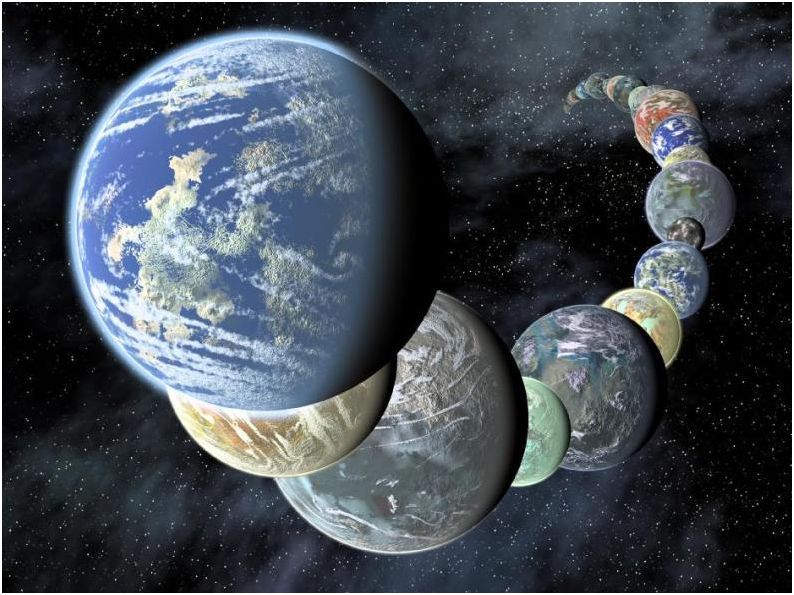
Astronomers Estimate That There at least 100 Billion Planets In the Galaxy

Science News article: Planets Abound: Astronomers Estimate That at Least 100 Billion Planets Populate the Galaxy

“There’s at least 100 billion planets in the galaxy — just our galaxy,” says John Johnson, assistant professor of planetary astronomy at Caltech and coauthor of the study, which was recently accepted for publication in the Astrophysical Journal. “That’s mind-boggling.”

From Science News Article:

http://www.sciencedaily.com/releases/2013/01/130103143422.htm?goback=.gmp_2074892.gde_2074892_member_201479279

This article  illustrates that the journey–and the scientific scenario–that Galileo helped kick off continues to this day. The scenario is as follows. When scientists put a device between themselves and that which is being observed it prompts an update in the models that make up a discipline of science.

PlanetEarthsMany

Picture Published in article

In the case of this article, the new measurement device is Kepler space telescope. Being is space, the telescope changes the perspective of the observation. The output of the device has a clarity that earth-based telescopes do not have.

When scientists make new observations and change models, it can cause “definitional dissonance” to some people. I saw an example of this in interesting factoid in the book “A Little History of Science” by William Bynum. In addition to upsetting the worldview held by the Catholic church, there was an even more basic reaction to the telescope itself. William reported  that people did not trust what was coming out of Galileo’s telescope.

They used denial as a means of alleviating their definitional dissonance.

But what this article illustrates the model of human behavior as “definers.” To view human knowledge without looking at all three elements–the observed, the observer, and the instruments used in the observation– one working with an incomplete model.

Understanding that this principle applies to two of human’s major efforts to understand the universe around us–science and religion–is vital when exploring the gap between the two.